
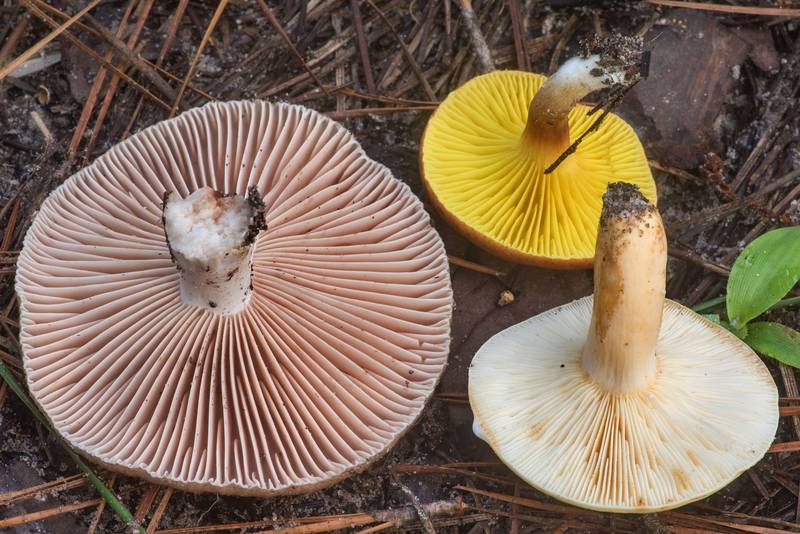

Blackening brittlegill (Russula eccentrica), Lactarius and Phylloporus mushrooms on Caney Creek section of Lone Star Hiking Trail in Sam Houston National Forest north from Montgomery. Texas


Album 2983: Sam Houston Forest, Texas, July 16, 2021
The image presents a close-up view of three distinct fungi species, showcasing their unique characteristics and features.
**Fungi Species:**
* **Blackening Brittlegill (Russula eccentrica):**
* The Blackening Brittlegill is prominently displayed in the center of the image.
* It boasts a large, flat cap with wavy edges and a white gills that gradually darken to black as they mature.
* The stem is short and stout, measuring approximately 1-2 inches (2.5-5 cm) tall.
* **Lactarius Mushrooms:**
* Two Lactarius mushrooms are visible on the right side of the image.
* Their caps range from light brown to dark brown in color, featuring wavy edges and a white gills that turn yellowish-brown upon maturity.
* The stems of these mushrooms are slender, measuring around 1-2 inches (2.5-5 cm) tall.
* **Phylloporus Mushrooms:**
* One Phylloporus mushroom is situated on the bottom right corner of the image.
* Its cap is small and conical in shape, with a smooth, velvety texture and a white gills that turn yellowish-brown upon maturity.
* The stem is short and slender, measuring approximately 0.5-1 inch (1.3-2.5 cm) tall.
**Additional Observations:**
* The background of the image features a layer of pine needles and twigs, indicating that the mushrooms are growing in a forest environment.
* A small green leaf is visible at the bottom center of the image, adding a touch of natural beauty to the scene.
* The overall atmosphere of the image suggests a serene and peaceful setting, with the mushrooms appearing to be thriving in their natural habitat.
In summary, the image showcases three distinct fungi species, each with its unique characteristics and features. The Blackening Brittlegill stands out due to its large size and distinctive cap coloration, while the Lactarius and Phylloporus mushrooms exhibit similar but smaller caps and stems. The background of pine needles and twigs adds a sense of authenticity to the scene, highlighting the importance of preserving natural habitats for these fascinating organisms. – AI vision
🇪🇸 Descripción en español / Spanish Description
En el tramo del sendero Lone Star Hiking Trail en Caney Creek dentro de la Sam Houston National Forest al norte de Montgomery, Texas, se observan hongos Russula eccentrica, Lactarius y Phylloporus, el 16 de julio de 2021. La imagen presenta una vista detallada de tres especies de hongos distintivos, mostrando sus características únicas.
**Especies de Hongos:**
* **Russula eccentrica (Blackening Brittlegill):** * El Blackening Brittlegill se muestra prominentemente en el centro de la imagen. * Presenta una amplia y plana gorra con bordes ondulados y unas filamentosas blanquecinas que se oscurecen hasta llegar a negro a medida que maduran. * El tallo es corto y grueso, midiendo aproximadamente de 2,5 a 5 cm (1-2 pulgadas) de altura.
* **Hongos Lactarius:** * Dos hongos Lactarius son visibles en el lado derecho de la imagen. * Su gorra presenta una variedad de colores que oscilan entre marrón claro y marrón oscuro, con bordes ondulados y filamentosas blancas que toman un tono marrón amarillento a medida que maduran. * Los tallos de estos hongos son delgados, midiendo alrededor de 2,5-5 cm (1-2 pulgadas) de altura.
* **Hongos Phylloporus:** * Un hongo Phylloporus se encuentra en la esquina inferior derecha de la imagen. * Su gorra es pequeña y cónica, con una textura lisa y velluda y unas filamentosas blancas que adquieren un tono marrón amarillento a medida que maduran. * El tallo es corto y delgado, midiendo aproximadamente de 1,3-2,5 cm (0,5-1 pulgada) de altura.
**Otros detalles:** * En el fondo de la imagen se pueden ver una capa de pinos y restos, lo que indica que los hongos crecen en un entorno forestal. * En el centro inferior de la imagen es visible una hoja verde, que añade toques naturales al escenario. * El ambiente general de la imagen transmite serenidad y paz y se puede observar cómo los hongos prosperan en su hábitat natural.
En resumen, la imagen muestra tres especies distintivas de hongos, cada una con sus características únicas. El Blackening Brittlegill sobresale por su gran tamaño y el color peculiar de su gorra. Por otra parte, los hongos Lactarius y Phylloporus presentan unas gorras y tallos similares pero más pequeños. La capa de pinos y restos añade autenticidad al escenario, subrayando la importancia de preservar el hábitat natural de estos fascinantes organismos. – Spanish translation


