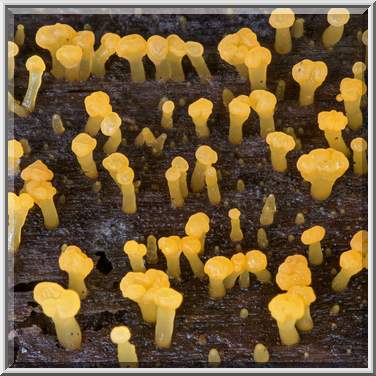
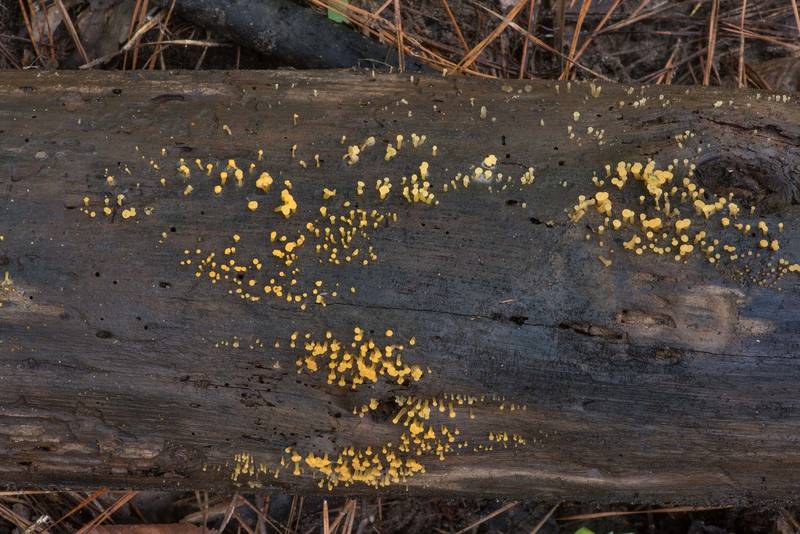
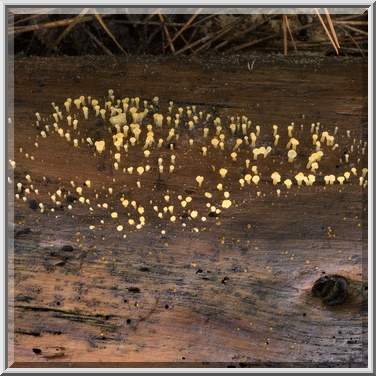
Colonies of jelly fungus Pale Stagshorn (Calocera pallidospathulata) or may be Dacrymyces on a fallen pine without bark on Caney Creek section of Lone Star Hiking Trail in Sam Houston National Forest north from Montgomery. Texas


Album 2984: Mushrooms in Sam Houston Forest, Texas, July 16, 2021
The image showcases two separate sections of a fallen pine tree trunk devoid of its bark, situated in a forest environment. The first section features colonies of yellowish-orange to orange-yellow jelly fungus, possibly Pale Stagshorn (Calocera pallidospathulata) or Dacrymyces, scattered across the surface. The second section is similar but does not display any visible signs of the fungi.
The pine trunk exhibits a dark brown color with some areas appearing black, and numerous holes can be seen along its length. In both sections, the wood has been weathered to a point where it appears to have started decaying. The image suggests that the fungus is likely growing on or within the tree trunk, as indicated by the yellowish-orange growths.
The pine tree lies on the ground in an undetermined location, surrounded by brown and orange grasses, twigs, and other debris. The overall atmosphere of the scene conveys a sense of decay and decomposition, with the fallen tree serving as a food source for various organisms in the forest ecosystem.
In summary, the image presents a close-up view of two sections of a fallen pine trunk covered in yellowish-orange jelly fungus growths, set against a backdrop of natural surroundings. – AI vision
🇪🇸 Descripción en español / Spanish Description
Las colonias de hongo gelatinoso Pale Stagshorn (Calocera pallidospathulata) o pueden ser Dacrymyces en un pino caído sin corteza en la sección del arroyo Caney del Lone Star Hiking Trail en el bosque nacional Sam Houston al norte de Montgomery. Texas, 16 de julio de 2021. La imagen muestra dos secciones separadas de un tronco de pino caído desprovisto de corteza, situado en un entorno forestal. La primera sección presenta colonias de hongo gelatinoso de color naranja amarillento a anaranjado, posiblemente Pale Stagshorn (Calocera pallidospathulata) o Dacrymyces, dispersas por la superficie. La segunda sección es similar pero no muestra signos visibles del hongo. El tronco de pino presenta un color marrón oscuro con áreas que parecen negras y se pueden observar numerosos agujeros a lo largo de su longitud. En ambas secciones, la madera ha sido erosionada hasta el punto de haber comenzado a descomponerse. Es probable que el hongo esté creciendo sobre o dentro del tronco del árbol, como indican los crecimientos de color naranja amarillento. El pino se encuentra en el suelo en un lugar no determinado, rodeado por hierbas marrones y naranjas, ramitas y otros desechos. La atmósfera general de la escena transmite una sensación de descomposición y descomposición, con el árbol caído sirviendo como fuente de alimento para diversos organismos en el ecosistema forestal. En resumen, la imagen presenta una vista detallada de dos secciones de un tronco de pino caído cubierto con crecimientos de hongo gelatinoso de color naranja amarillento, frente a un fondo natural. – Spanish translation


