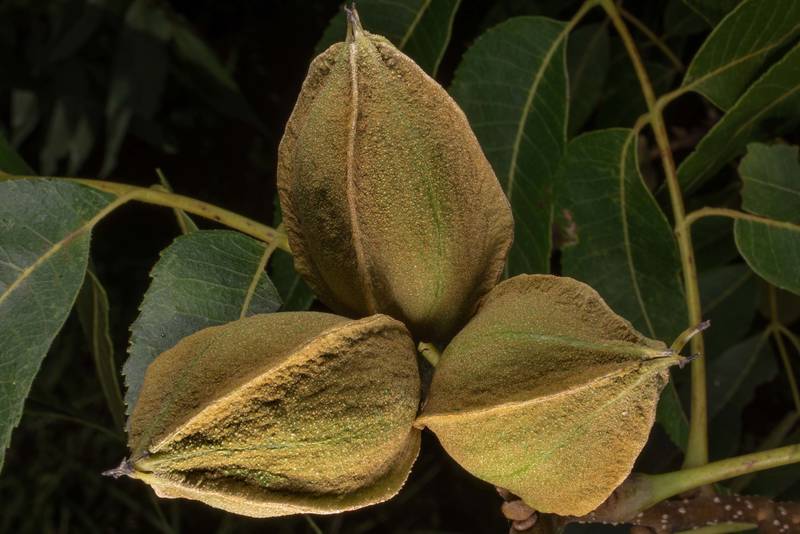

Emerging green fruits on a pecan tree near Ferry Rd. in Washington-on-the-Brazos State Historic Site. Washington, Texas


Album 2996: Washington-on-the-Brazos, Texas, July 31, 2021
The image showcases two developing pecan fruits emerging from their husks on a pecan tree at the Washington-on-the-Brazos State Historic Site near Ferry Road in Washington, Texas. The pecans are still encased in greenish-brown husks that protect them from damage. As they mature, the husks will dry and split open, leaving just the hard outer shell of the nut visible.
The branch is adorned with large, dark green leaves, which are typical for pecan trees. The leaves have an oval shape, serrated edges, and a pointed tip, indicating that this specimen is likely Pecan tree (Carya illinoensis). The image was captured in July 2021, just as the fruits were beginning to emerge from their husks.
The setting of the image is Washington-on-the-Brazos State Historic Site, located near Ferry Road in Washington, Texas. This site preserves and interprets an important part of Texas history, including its role as the location where Texas declared independence from Mexico on March 2, 1836. The pecan tree, with its beautiful foliage and edible nuts, adds to the natural beauty and historical significance of this area.
Overall, the image provides a glimpse into the life cycle of pecans and highlights the importance of preserving our natural heritage while also appreciating the rich history that surrounds us. – AI vision
🇪🇸 Descripción en español / Spanish Description
En un árbol de pacanas cerca de Ferry Road en el Washington-on-the-Brazos State Historic Site. Washington, Texas, 31 de julio de 2021. La imagen muestra dos frutos en desarrollo de pacana que emergen de sus cáscaras en un árbol de pacanas en el sitio histórico de Washington-on-the-Brazos State Historic Site cerca de Ferry Road en Washington, Texas. Las pacanas aún están encerradas en cáscaras marrones verdosas que las protegen del daño. A medida que maduran, las cáscaras se secarán y se abrirán dejando solo la dura cáscara exterior de la nuez. El ramal está adornado con hojas grandes y verdes oscuras, típicas para los árboles de pacanas. Las hojas tienen una forma ovalada, bordes serrados y una punta puntiaguda, lo que indica que este espécimen es probablemente un árbol de pacana (Carya illinoensis). La imagen fue capturada en julio de 2021, justo cuando los frutos estaban comenzando a emerger de sus cáscaras. El entorno de la imagen es el Washington-on-the-Brazos State Historic Site, ubicado cerca de Ferry Road en Washington, Texas. Este sitio preserva e interpreta una parte importante de la historia de Texas, incluyendo su papel como lugar donde Texas declaró la independencia de México el 2 de marzo de 1836. El árbol de pacanas, con su hermosa vegetación y nueces comestibles, agrega belleza natural y significado histórico a esta área. En general, la imagen proporciona un vistazo al ciclo de vida de las pacanas y resalta la importancia de preservar nuestro patrimonio natural mientras también apreciamos la rica historia que nos rodea. – Spanish translation