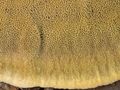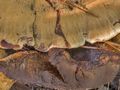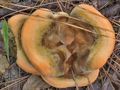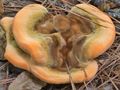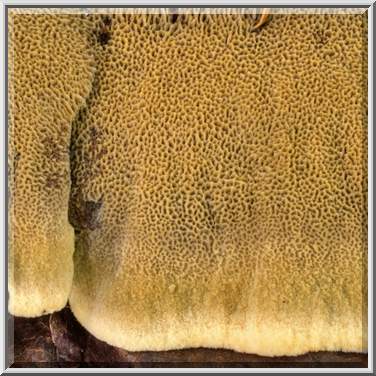
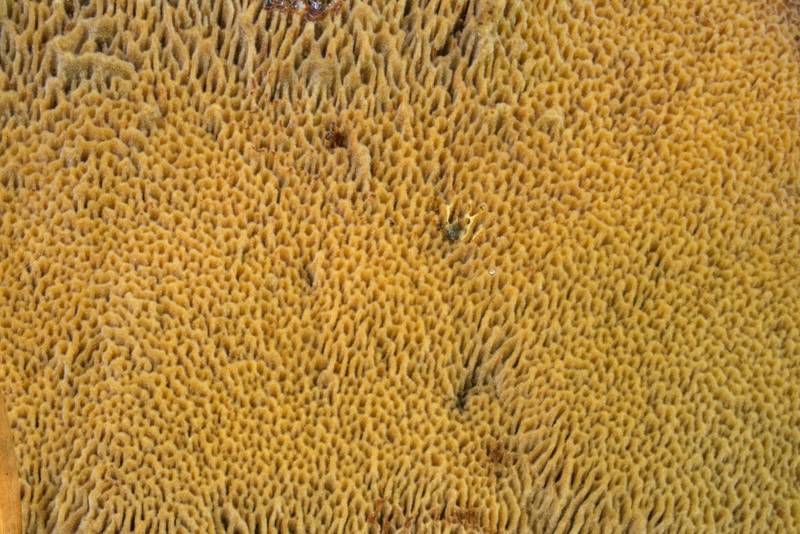
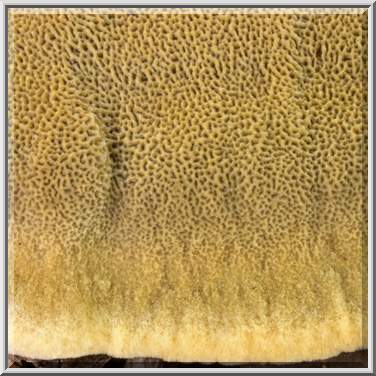
Pore surface of Dyer's mazegill mushroom (Phaeolus schweinitzii) on Caney Creek Trail (Little Lake Creek Loop Trail) in Sam Houston National Forest north from Montgomery. Texas


Album 3011: College Station - Sam Houston Forest, Texas, August 19 - 22, 2021
The image presents a detailed view of the pore surface of Dyer's mazegill mushroom (Phaeolus schweinitzii), captured on Caney Creek Trail within Sam Houston National Forest north from Montgomery, Texas, during August 22, 2021.
Upon closer inspection of this section of the fungus, it becomes evident that its primary method of obtaining nutrients is through a process known as "decomposer." This involves releasing enzymes into the surrounding environment to break down organic matter and absorb the resulting nutrients. The image highlights the intricate structure of the pore surface, which plays a crucial role in facilitating this decomposition process.
The texture of the pores appears to be quite dense and uniform, with each pore being roughly similar in size. The coloration is a light brown hue, likely due to the presence of melanin or other pigments that contribute to its natural coloring. This characteristic coloration may serve as a defense mechanism against potential predators by making it less appealing to them.
Overall, the image provides valuable insights into the unique characteristics and functions of Dyer's mazegill mushroom, highlighting its importance in the ecosystem as both a decomposer and food source for various organisms. – AI vision
🇪🇸 Descripción en español / Spanish Description
Superficie de poro del hongo Mazegill de Dyer (Phaeolus schweinitzii) en el Caney Creek Trail (Little Lake Creek Loop Trail) en Sam Houston National Forest al norte de Montgomery. Texas, 22 de agosto de 2021. La imagen presenta una vista detallada de la superficie de poro del hongo Mazegill de Dyer (Phaeolus schweinitzii), capturado en el Caney Creek Trail dentro del bosque nacional Sam Houston al norte de Montgomery, Texas, durante el 22 de agosto de 2021. Tras un análisis más detallado de esta sección del hongo, resulta evidente que su principal método para obtener nutrientes es a través de un proceso conocido como "descomposición". Esto implica liberar enzimas al medio circundante para descomponer la materia orgánica y absorber los nutrientes resultantes. La imagen destaca la estructura intrincada de la superficie del poro, que desempeña un papel crucial en facilitar este proceso de descomposición. La textura de los poros parece ser bastante densa y uniforme, siendo cada poro aproximadamente del mismo tamaño. La coloración es un matiz marrón claro, probablemente debido a la presencia de melanina u otros pigmentos que contribuyen a su color natural. Esta característica coloración puede servir como mecanismo de defensa contra posibles depredadores al hacerlo menos atractivo para ellos. En general, la imagen proporciona información valiosa sobre las únicas características y funciones del hongo Mazegill de Dyer, destacando su importancia en el ecosistema como descompostor y fuente de alimento para diversos organismos. – Spanish translation