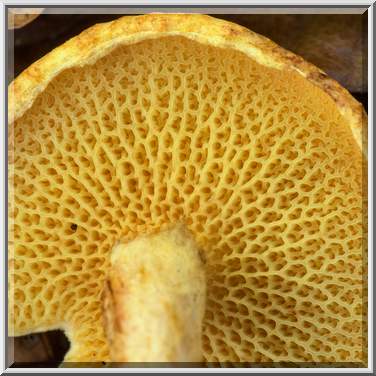
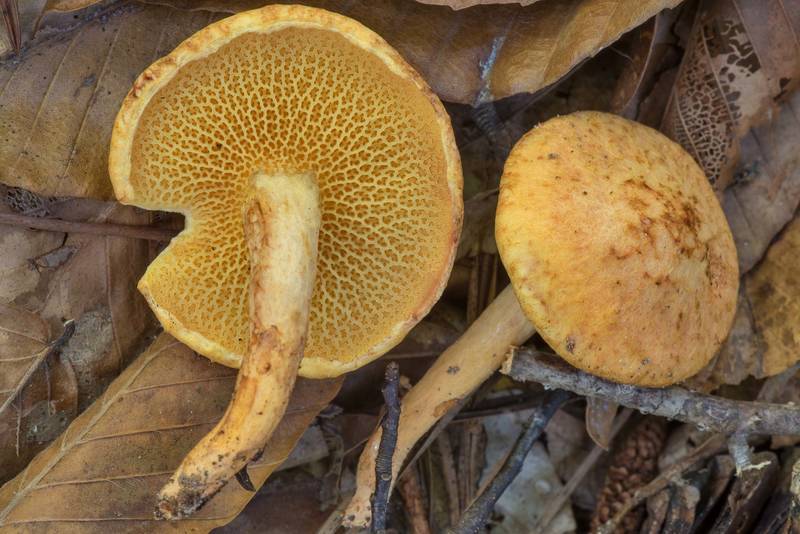
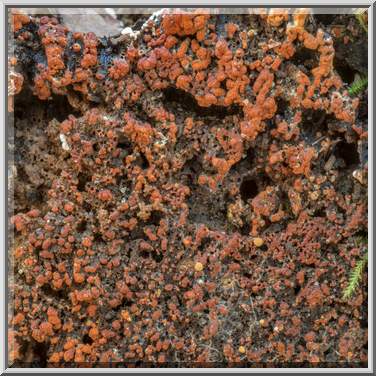
Bolete mushrooms Suillus decipiens on Kirby Trail in Big Thicket National Preserve. Warren, Texas


Album 3029: Big Thicket - Sam Houston Forest, Texas, September 25 - 26, 2021
The image depicts a close-up view of three yellow-orange mushrooms known as Boletus decipiens or "deceitful bolete" lying on a bed of fallen leaves and twigs. The mushroom caps are roughly circular with irregular edges, ranging in size from about 2.5 to 4 inches (6-10 cm) in diameter. They feature yellow-orange hues and a distinctive pattern of pores that resemble tiny holes, arranged in an intricate mesh-like design.
The stems are long and thin, varying in length from approximately 3 to 7 inches (8-18 cm). The caps sit atop the stems at a slightly slanted angle. The mushrooms rest on a layer of brown leaves and twigs scattered across the ground. This suggests that they have recently fallen or been knocked down by wind or rain.
The presence of these Boletus decipiens mushrooms in this setting implies that they are common in Big Thicket National Preserve, particularly in areas with rich soil and ample moisture. The fact that they are lying on the ground rather than growing upright indicates that they may have been recently foraged or disturbed by animals.
Overall, the image provides a detailed view of these intriguing fungi, highlighting their unique characteristics and habitat preferences. It serves as a valuable resource for mushroom enthusiasts, researchers, and anyone interested in learning more about the diverse range of organisms found in nature. – AI vision
🇪🇸 Descripción en español / Spanish Description
Los hongos Bolete Suillus decipiens en el sendero Kirby del Big Thicket National Preserve. Warren, Texas, 25 de septiembre de 2021. La imagen muestra una vista detallada de tres hongos amarillo-naranja conocidos como Boletus decipiens o "bolete engañoso" tumbados sobre una capa de hojas y ramitas caídas. Las setas tienen unas cabezas aproximadamente circulares con bordes irregulares, que varían en tamaño entre 6-10 cm de diámetro. Presentan tonalidades amarillo-naranja y una pauta distintiva de poros similares a pequeños agujeros dispuestos como un intrincado diseño de malla. Los tallos son largos y delgados, con longitudes que oscilan entre 8-18 cm. Las cabezas se disponen encima de los tallos en ángulo ligeramente inclinado. Los hongos reposan sobre una capa de hojas pardas y ramitas esparcidas por el suelo. Esto sugiere que han caído o han sido derribados por el viento o la lluvia. La presencia de estos hongos Boletus decipiens en este entorno implica que son comunes en el Big Thicket National Preserve, en especial, en zonas con suelo rico y humedad abundante. El hecho de que reposen sobre el suelo en lugar de crecer erguidos indica que pueden haber sido recolectados o molestados por animales. En general, la imagen ofrece una vista detallada de estos hongos fascinantes, resaltando sus características únicas y preferencias de hábitat. Sirve como recurso valioso para los aficionados a los hongos, investigadores y cualquier persona interesada en saber más sobre la diversa gama de organismos que se encuentran en la naturaleza. – Spanish translation


