
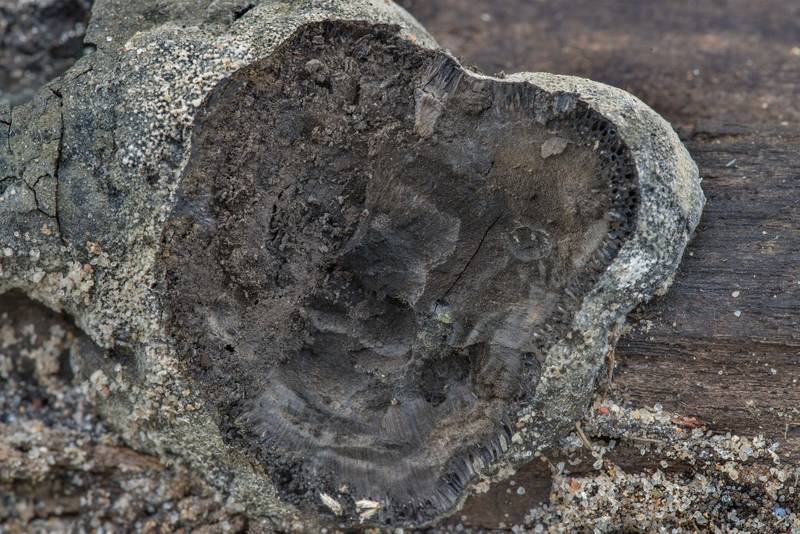

Cross section of some black Daldinia like fungus growing on Hypoxylon crust on a fallen tree on Caney Creek Trail (Little Lake Creek Loop Trail) in Sam Houston National Forest north from Montgomery. Texas


Album 3029: Big Thicket - Sam Houston Forest, Texas, September 25 - 26, 2021
The image presents a detailed cross-section of a black Daldinia-like fungus growing on Hypoxylon crust, likely originating from a fallen tree situated along Caney Creek Trail (Little Lake Creek Loop Trail) within Sam Houston National Forest north of Montgomery, Texas.
**Fungal Growth**
* The fungus exhibits a distinctive black coloration and appears to be growing in a circular pattern.
* It is embedded in the Hypoxylon crust, which covers much of the fallen tree's surface.
* The fungus may have formed from spores that germinated within the decaying wood, resulting in its unique appearance.
**Background**
* The surrounding environment is characterized by a dark brown or grayish-brown hue, likely due to the presence of other fungi and lichens.
* Small pieces of bark and debris are scattered about, indicating the forest's natural state of decomposition.
**Overall Context**
* The image provides an intimate look at the intricate relationships between different organisms in a forest ecosystem.
* It highlights the complex interactions that occur within these environments and the importance of preserving these delicate balances for future generations. – AI vision
🇪🇸 Descripción en español / Spanish Description
Transcripción del texto en español
Sección transversal de un hongo negro de tipo Daldinia que crece en la costra de Hypoxylon en un árbol caído en el Caney Creek Trail (Little Lake Creek Loop Trail) en el Bosque Nacional Sam Houston al norte de Montgomery. Texas, septiembre 26, 2021. La imagen presenta una sección transversal detallada de un hongo negro de tipo Daldinia que crece en la costra de Hypoxylon, probablemente originado a partir de un árbol caído situado a lo largo del Caney Creek Trail (Little Lake Creek Loop Trail) dentro del Bosque Nacional Sam Houston al norte de Montgomery, Texas. *Crecimiento Fúngico*
El hongo presenta una coloración negra distintiva y parece estar creciendo en un patrón circular.
Está incrustado en la costra de Hypoxylon, que cubre gran parte de la superficie del árbol caído.
El hongo puede haberse formado a partir de esporas que germinaron dentro de la madera en descomposición, dando como resultado su aspecto único.
**Antecedentes**
* El entorno circundante se caracteriza por un tono marrón oscuro o parduzco, probablemente debido a la presencia de otros hongos y líquenes. * Piezas pequeñas de corteza y escombros están dispersas, lo que indica el estado natural de descomposición del bosque.
**Contexto General**
* La imagen ofrece una mirada a las intrincadas relaciones entre diferentes organismos en un ecosistema forestal.
* Destaca las complejas interacciones que ocurren dentro de estos entornos y la importancia de preservar estos delicados equilibrios para las generaciones futuras. – Spanish translation


