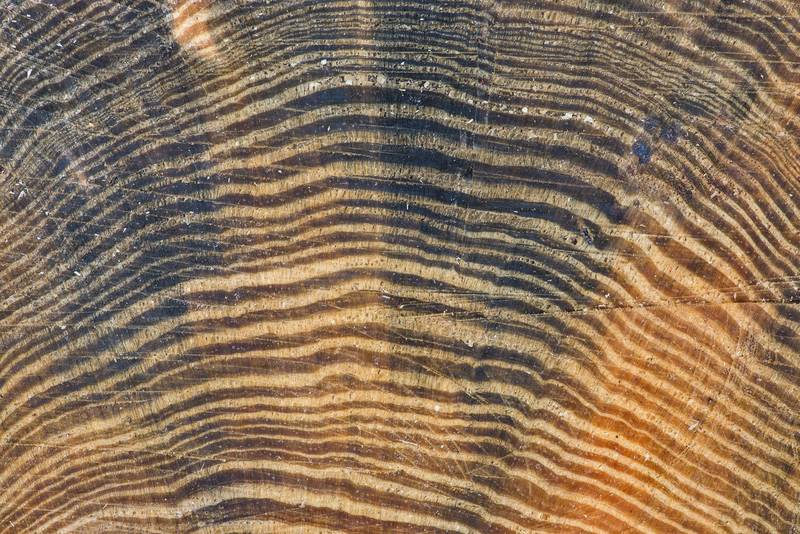

Radial pattern of a recently cut pine tree on Caney Creek Trail (Little Lake Creek Loop Trail) in Sam Houston National Forest north from Montgomery. Texas

Album 3034: Sam Houston Forest, Texas, October 6, 2021
The image showcases the radial pattern of a recently cut pine tree trunk, with its bark stripped away to reveal the intricate growth rings. The rings are concentric and arranged in a circular pattern around the center of the trunk, indicating that the tree was cut from the side.
**Key Features**
* **Growth Rings**: The rings vary in color, ranging from light yellowish-white at the outermost edges to dark brown towards the center.
* **Ring Patterns**: Each ring represents one year of growth, with the width of each ring corresponding to the amount of rainfall or moisture during that particular growing season. A wider ring indicates a year with adequate moisture, while a narrower ring suggests a dry period.
* **Tree Species**: The tree is identified as a pine species based on its needle-like leaves and cone shape.
**Conclusion**
The radial pattern of the recently cut pine tree trunk provides valuable information about the tree's growth history. By examining the width and coloration of each growth ring, researchers can reconstruct the climate conditions during each growing season, offering insights into past environmental conditions and the impact of human activities on the forest ecosystem. – AI vision
🇪🇸 Descripción en español / Spanish Description
El patrón radial de un pino recientemente cortado en el camino Caney Creek (Sendero del bucle del pequeño arroyo Little Lake) en la Selva Nacional Sam Houston, al norte de Montgomery, Texas, el 6 de octubre de 2021. La imagen muestra el patrón radial del tronco de un pino recientemente cortado, con su corteza arrancada para revelar los intrincados anillos de crecimiento. Los anillos son concéntricos y están dispuestos en un patrón circular alrededor del centro del tronco, lo que indica que el árbol se cortó desde el lado. * **Características clave** * **Anillos de crecimiento**: Los anillos varían en color, oscilando entre un blanco amarillento claro en los bordes más exteriores a marrón oscuro hacia el centro. * **Patrones de anillos**: Cada anillo representa un año de crecimiento, con el ancho de cada anillo correspondiente a la cantidad de lluvia o humedad durante esa temporada de crecimiento particular. Un anillo más ancho indica un año con humedad adecuada, mientras que un anillo más estrecho sugiere un período seco. * **Especie arbórea**: El árbol se identifica como una especie de pino en función de sus hojas de tipo aguja y forma de cono. **Conclusión** El patrón radial del tronco de un pino recientemente cortado proporciona información valiosa sobre la historia de crecimiento del árbol. Al examinar el ancho y coloración de cada anillo de crecimiento, los investigadores pueden reconstruir las condiciones climáticas durante cada temporada de crecimiento, ofreciendo insights en las condiciones ambientales pasadas y el impacto de las actividades humanas en el ecosistema forestal. – Spanish translation


