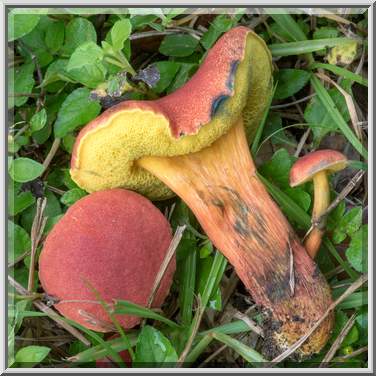
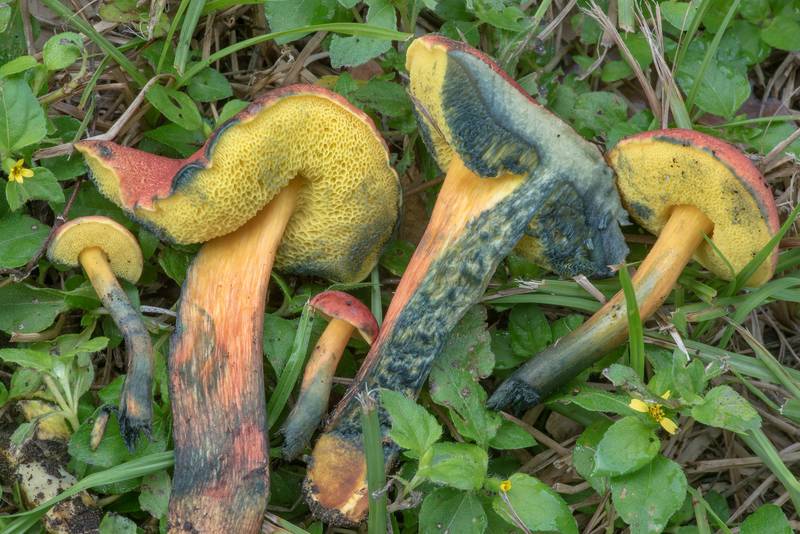

Cross section of mushrooms Hortiboletus campestris (Boletus campestris) under crape myrtle and live oaks in College Station Cemetery. College Station, Texas


Album 3049: College Station, Texas, October 25 - XX, 2021
The image presents a cross-section of mushrooms from the species Hortiboletus campestris (previously classified as Boletus campestris), set against an autumnal backdrop in College Station Cemetery. The photograph provides a detailed view of the mushroom's internal structure, showcasing its unique characteristics.
**Physical Characteristics**
* The mushroom has a yellowish to orange cap with brown or tan pores underneath.
* The stem is typically shorter than the cap and slightly thicker at the base.
* The flesh is white to pale yellow, with a mild, earthy flavor when cooked.
**Habitat and Distribution**
* Hortiboletus campestris can be found growing in grasslands, open woods, and along roadsides.
* They prefer well-drained soils and are often associated with oak and pine trees.
* The species is native to North America but has been introduced to other parts of the world.
**Conservation Status**
* Hortiboletus campestris is not considered a threatened or endangered species.
* However, its habitat destruction and overcollection for food have raised concerns about its long-term sustainability.
**Culinary Uses**
* The mushroom is edible and can be used in various dishes, including soups, stews, and sauces.
* It has a mild flavor and firm texture when cooked, making it a popular choice among mushroom enthusiasts. – AI vision
🇪🇸 Descripción en español / Spanish Description
Sección transversal de hongos Hortiboletus campestris (Boletus campestris) bajo mirto y robles en el cementerio de College Station. College Station, Texas, 25 de octubre de 2021. La imagen presenta una sección transversal de hongos de la especie Hortiboletus campestris (previamente clasificada como Boletus campestris), contra un fondo otoñal en el cementerio de College Station. La fotografía proporciona una vista detallada de la estructura interna del hongo, mostrando sus características únicas. **Características Físicas** * El hongo tiene una tapa amarillenta a naranja con poros marrones o castaños debajo. * El tallo es típicamente más corto que la tapa y ligeramente más grueso en la base. * La carne es blanca a amarillo pálido, con un sabor suave y terroso cuando se cocina. **Hábitat y Distribución** * Hortiboletus campestris puede encontrarse creciendo en praderas, bosques abiertos y junto a carreteras. * Prefieren suelos bien drenados y a menudo están asociados con robles y pinos. * La especie es nativa de Norteamérica, pero se ha introducido en otras partes del mundo. **Estado de Conservación** * Hortiboletus campestris no se considera una especie amenazada o en peligro de extinción. * Sin embargo, su destrucción de hábitats y la recolección excesiva para alimentos han generado preocupaciones sobre su viabilidad a largo plazo. **Usos Culinarios** * El hongo es comestible y se puede utilizar en varios platos, incluidas sopas, guisados y salsas. * Tiene un sabor suave y una textura firme cuando se cocina, lo que lo convierte en un favorito entre los amantes de los hongos. – Spanish translation


