 |
| |||||||||||||||||

| ||||||||||||||||||


| Similar |   |
  |
  |
  |
  |
| |||||||||||||||||||||||||||||
| |||||||||||||||||||||||||||||
| 1996 1997 1998 1999 2000 2001 2002 2003 2004 2005 2006 2007 2008 2009 2010 2011 2012 2013 2014 2015 2016 2017 2018 2019 2020 2021 2022 2023 2024 2025 2026 | |||||||||||||||||||||||||||||
| New version Slide Show Most Popular Full List Statistics Technical Details Home Page | |||||||||||||||||||||||||||||
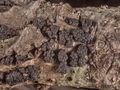
Black crust fungus Annulohypoxylon annulatum(?) thrives on logs in the Big Creek Scenic Area of Sam Houston National Forest, Shepherd, Texas. This photograph was taken on November 21, 2021, showcasing the intricate patterns and colors of the fungus. – generated by AI |
The image presents a close-up view of a dark-colored crust fungus growing on the surface of a decaying log. The fungus exhibits a blackish-brown hue with a slightly lighter brown texture. Its irregularly shaped clusters are visible, characterized by rounded protrusions that resemble small balls or berries. These clusters appear to be randomly distributed across the log's surface. The background of the image features the weathered and worn wood grain of the decaying log, which is likely from a deciduous tree species. The overall appearance suggests that the fungus has been growing on this log for an extended period, as indicated by its dense growth and the presence of small fragments of debris scattered throughout the image. The image provides valuable information about the habitat and ecological significance of Annulohypoxylon annulatum, a type of crust fungus. The fact that it is growing on a decaying log suggests that this species plays an important role in breaking down organic matter and recycling nutrients in forest ecosystems. Additionally, the presence of small fragments of debris in the image implies that the fungus may be involved in decomposing plant material and contributing to nutrient cycling. In summary, the image offers a detailed view of Annulohypoxylon annulatum growing on a decaying log, highlighting its unique characteristics and ecological significance. The image provides valuable insights into the habitat and behavior of this crust fungus species, which is likely an important component of forest ecosystems. – AI vision |
Hongo de corteza negra Annulohypoxylon annulatum(?) en un tronco en el área panorámica del río Big de la Selva Nacional Sam Houston. Shepherd, Texas, 21 de noviembre de 2021. La imagen presenta una vista detallada de un hongo de corteza oscuro que crece en la superficie de un tronco en descomposición. El hongo exhibe un tono marrón negruzco con una textura marrón ligeramente más clara. Sus racimos irregularmente conformados son visibles, caracterizados por protuberancias redondeadas que recuerdan a pequeñas bolas o bayas. Estos racimos parecen estar distribuidos aleatoriamente en la superficie del tronco. El fondo de la imagen presenta el desgaste y la madera gastada del tronco en descomposición, probablemente de una especie de árbol deciduo. La apariencia general sugiere que el hongo ha crecido en este tronco durante un período prolongado, como lo indica su crecimiento denso y la presencia de pequeños fragmentos de restos esparcidos por toda la imagen. La imagen proporciona información valiosa sobre el hábitat y la importancia ecológica de Annulohypoxylon annulatum, un tipo de hongo de corteza. El hecho de que crezca en un tronco en descomposición sugiere que esta especie juega un papel importante en la descomposición de materia orgánica y el reciclaje de nutrientes en los ecosistemas forestales. Además, la presencia de pequeños fragmentos de restos en la imagen implica que el hongo puede estar descomponiendo material vegetal y contribuyendo al ciclo de nutrientes. En resumen, la imagen ofrece una vista detallada del Annulohypoxylon annulatum creciendo en un tronco en descomposición, destacando sus características únicas y su importancia ecológica. El hecho de que crezca en un tronco en descomposición sugiere que esta especie es un componente importante de los ecosistemas forestales. – Spanish translation |
Keyword variants
high resolution online digital collection
Houston National Forest photo
Lone Star State
United States
picture gallery
photo album
documentary photographs
daily pics
TX
travelogue
snapshots
sightseeing
photowalks
photoblog
graphic
fotografias
foto
America