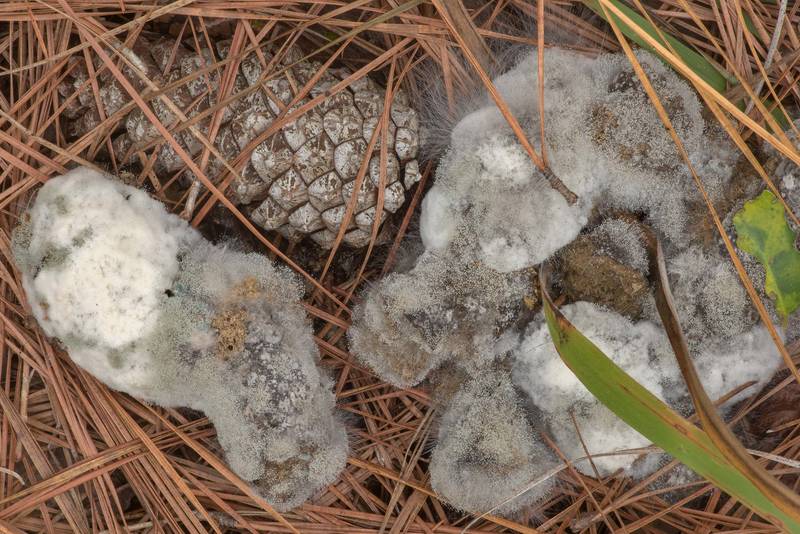

White filamentous mold fungus Phycomyces(?) on feces on a trail on Sand Branch Loop Trail in Sam Houston National Forest near Montgomery. Texas


Album 3077: Mushrooms in Sam Houston Forest, Texas, December 5, 2021
The image presents a close-up view of white filamentous mold fungus, identified as Phycomyces(?), growing on feces along the Sand Branch Loop Trail within Sam Houston National Forest near Montgomery, Texas. The photograph was captured on December 5, 2021.
Upon initial observation, the primary focus is on the white, fuzzy fungal growth covering a portion of the fecal matter. The fungus appears to have grown extensively over the entire surface visible in the image, obscuring any details beneath it. The surrounding environment provides context for the scene, with brown pine needles and green grass blades providing a natural setting.
The use of the ellipsis after Phycomyces suggests that the species may not be definitively identified as this particular genus or may require further study to confirm its classification. This notation is commonly used in scientific documentation when there are uncertainties regarding taxonomy or identification.
In conclusion, the image captures a moment in time where the white filamentous mold fungus has colonized feces on a trail in Sam Houston National Forest. The scene offers an opportunity for observation and study of the natural world, highlighting the diversity of organisms that inhabit our environment. – AI vision
🇪🇸 Descripción en español / Spanish Description
Hongo filamentoso blanco Phycomyces(?) en heces de un camino en el sendero Sand Branch Loop Trail en la Sam Houston National Forest cerca de Montgomery, Texas, 5 de diciembre de 2021. La imagen presenta una vista cercana del hongo filamentoso blanco, identificado como Phycomyces(?), que crece sobre heces a lo largo del sendero Sand Branch Loop Trail dentro de la Sam Houston National Forest cerca de Montgomery, Texas. La fotografía fue capturada el 5 de diciembre de 2021. Tras una observación inicial, el enfoque primario está sobre el crecimiento fúngico blanco y peludo que cubre parte del material fecal. El hongo parece haberse desarrollado extensamente por toda la superficie visible en la imagen, ocultando cualquier detalle debajo de ella. El entorno circundante proporciona contexto para la escena, con hojas marrones de pino y hierba verde que brindan un escenario natural. El uso de la elipsis después de Phycomyces sugiere que la especie puede no estar definitivamente identificada como este género particular o puede requerir un estudio más detallado para confirmar su clasificación. Esta notación se utiliza comúnmente en documentos científicos cuando existen incertidumbres en cuanto a taxonomía o identificación. En conclusión, la imagen captura un momento en el que el hongo filamentoso blanco ha colonizado heces en un camino de la Sam Houston National Forest. La escena ofrece una oportunidad para observar y estudiar el mundo natural, destacando la diversidad de organismos que habitan nuestro entorno. – Spanish translation