
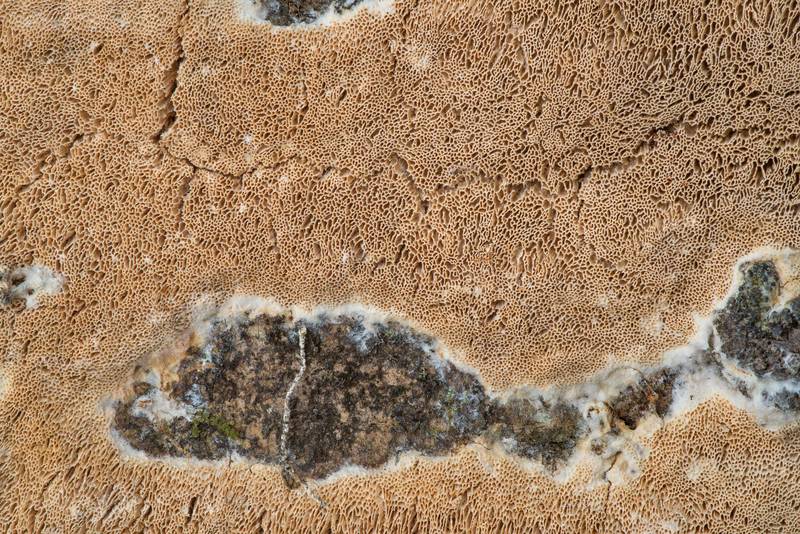

Split porecrust fungus (Schizopora paradoxa)(?) and its margins on a fallen branch near Pole Creek on North Wilderness Trail of Little Lake Creek Wilderness in Sam Houston National Forest north from Montgomery. Texas


Album 3081: College Station - Sam Houston Forest, Texas, December 14 - 15, 2021
The image depicts a close-up view of a fungus growing on a fallen tree branch, specifically the Split porecrust fungus (Schizopora paradoxa).
In the center of the image, there is an irregularly shaped patch of dark brown, possibly black, with lighter-colored borders. The edges of this patch are outlined by white, fuzzy-looking material that appears to be the fruiting body of the fungus. The surrounding area is covered in a thick layer of tan-colored, web-like growths that resemble coral or lace. These growths appear to be tightly packed together and have a delicate, almost translucent appearance.
The overall texture and pattern of the growth suggest that it is a type of bracket fungus, which grows on decaying wood and has a distinctive cap-like structure. The presence of white fuzz along the edges of the patch suggests that the fungus may be in the process of releasing spores into the air.
The background of the image shows more of the same tan-colored growths covering the surface of the tree branch, providing context for the main subject of the photo. Overall, the image provides a detailed view of the Split porecrust fungus and its unique characteristics. – AI vision
🇪🇸 Descripción en español / Spanish Description
El hongo de corteza porosa dividida (Schizopora paradoxa) y sus márgenes en una rama caída cerca del arroyo Pole en el Sendero North Wilderness de Little Lake Creek Wilderness en el bosque nacional Sam Houston al norte de Montgomery, Texas, el 15 de diciembre de 2021. La imagen muestra una vista detallada de un hongo que crece en una rama de árbol caída, específicamente el hongo de corteza porosa dividida (Schizopora paradoxa). En el centro de la imagen, hay una mancha de color marrón oscuro, posiblemente negro, con bordes de color más claro. Los bordes de esta mancha están delineados por material blanco y esponjoso que parece ser el cuerpo fructífero del hongo. La zona circundante está cubierta por una capa gruesa de crecimientos similares a la red o al encaje, de color canela. Estos crecimientos parecen estar estrechamente empaquetados y tienen un aspecto delicado y casi translúcido. El patrón general de crecimiento sugiere que se trata de un tipo de hongo en forma de casquete, que crece sobre madera en descomposición y tiene una estructura característica similar a la tapa. La presencia de material blanco esponjoso a lo largo de los bordes de la mancha sugiere que el hongo podría estar liberando esporas al aire. El fondo de la imagen muestra más de los mismos crecimientos de color canela cubriendo la superficie de la rama del árbol, proporcionando contexto para el tema principal de la foto. En general, la imagen ofrece una vista detallada del hongo de corteza porosa dividida y sus características únicas. – Spanish translation


