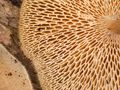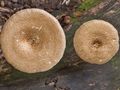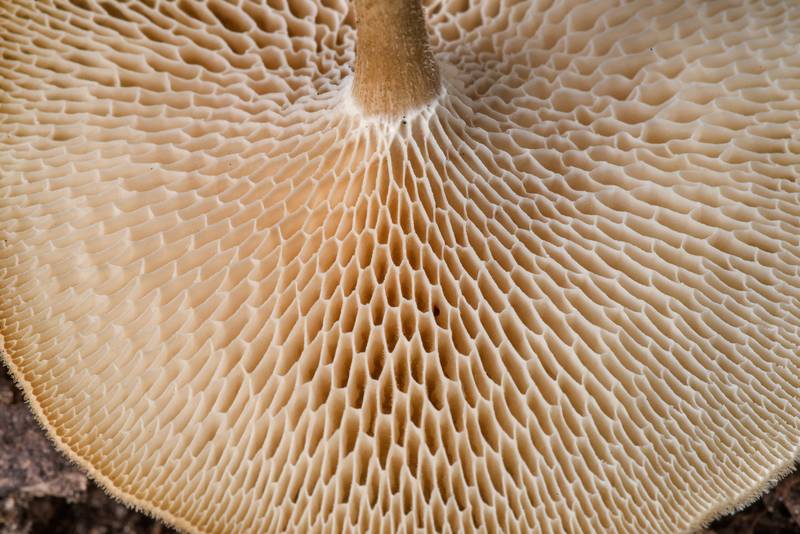

Underside of spring polypore mushroom (Lentinus arcularius) in Bee Creek Park. College Station, Texas


Album 3082: College Station, Texas, December 16 - 17, 2021
The image presents a detailed view of the underside of a spring polypore mushroom, showcasing its intricate structure and texture.
* **Mushroom Cap**
* The cap is large and flat, with a smooth surface that appears to be slightly concave in the center.
* It has a light brown color with darker brown spots or patches scattered throughout.
* The edges of the cap are wavy and irregularly shaped.
* **Gills**
* The gills are closely packed, thin, and white.
* They are attached to the stem at an angle, giving them a distinctive shape.
* The gills are covered in tiny, white hairs or fibers that give them a soft appearance.
* **Stem**
* The stem is long and slender, with a smooth surface that is slightly darker than the cap.
* It tapers gradually towards the base, where it attaches to the mycelium.
* There are no visible rings or other features on the stem.
* **Background**
* The background of the image is out of focus, but it appears to be a natural setting such as a forest floor or a wooded area.
* There are some dark shapes in the background that may be rocks, logs, or other objects.
In summary, the image provides a detailed view of the underside of a spring polypore mushroom, showcasing its unique cap shape, gill structure, and stem characteristics. The image also suggests a natural setting for the mushroom, possibly on a forest floor or in a wooded area. – AI vision
🇪🇸 Descripción en español / Spanish Description
El lado inferior de un hongo Poliporo de primavera (Lentinus arcularius) en el Bee Creek Park. College Station, Texas, 17 de diciembre de 2021. La imagen muestra una vista detallada del lado inferior de un hongo poliporo de primavera, mostrando su estructura y textura intrincadas. * **Sombrero del hongo** * El sombrero es grande y plano, con una superficie lisa que parece ser ligeramente cóncava en el centro. * Tiene un color marrón claro con manchas o parches marrones más oscuros dispersos por toda su superficie. * Los bordes del sombrero son ondulados y de forma irregular. **Laminillas** * Las laminillas están muy juntas, finas y blancas. * Están unidas al tallo formando un ángulo, dándoles una forma distintiva. * Las laminillas están cubiertas con pelos o fibras finas que les dan un aspecto suave. **Tallo** * El tallo es largo y delgado, con una superficie lisa que es ligeramente más oscura que el sombrero. * Se estrecha gradualmente hacia la base, donde se une al micelio. * No hay anillos u otros detalles visibles en el tallo. **Antecedentes** * Los antecedentes de la imagen están desenfocados, pero parecen ser un entorno natural como el suelo forestal o un área boscosa. * Hay algunas formas oscuras en el fondo que pueden ser rocas, troncos u otros objetos. En resumen, la imagen muestra una vista detallada del lado inferior de un hongo poliporo de primavera, mostrando su forma única de sombrero, estructura de laminillas y características del tallo. La imagen también sugiere un entorno natural para el hongo, posiblemente en el suelo forestal o en un área boscosa. – Spanish translation