
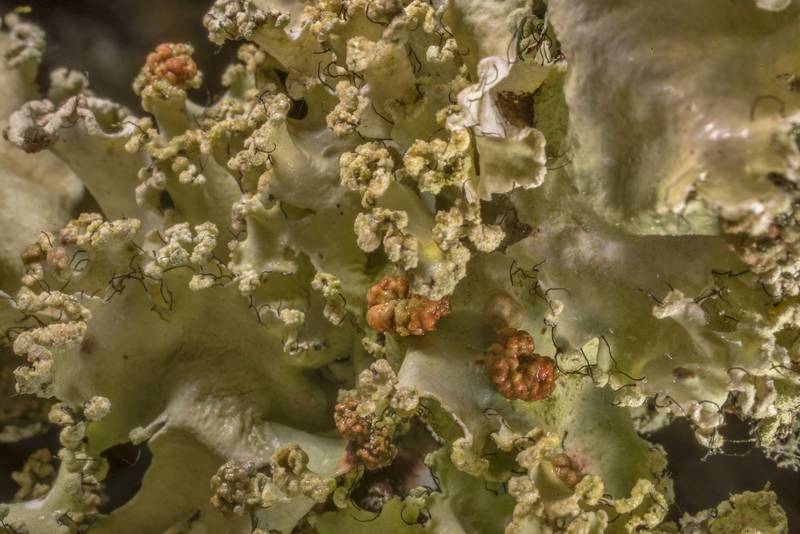

Powdered ruffle lichen (Parmotrema hypotropum) together with a parasitic gall-forming lichenicolous fungus Tremella parmeliarum on a twig of upland swamp-privet bush at Lake Somerville Trailway near Birch Creek Unit of Somerville Lake State Park. Texas


Album 3084: Lake Somerville, Texas, December 20, 2021
The image presents a close-up view of the Powdered ruffle lichen (Parmotrema hypotropum) and its associated parasitic gall-forming fungus, Tremella parmeliarum. The lichen's pale greenish-yellow hue is characterized by irregularly shaped lobes that form a distinctive "ruffled" appearance. These lobes are densely packed with tiny black or brownish-black apothecia (asexual fruiting bodies) and numerous fine black lines that traverse the surface, providing a striking contrast to the lichen's soft coloration.
The parasitic fungus, Tremella parmeliarum, is easily identifiable due to its bright orange-red hue. The fungus forms small, irregularly shaped masses on the lichen's surface, giving it a "gall-like" appearance. These fungal growths are likely a result of symbiotic or parasitic relationships between the fungus and the lichen.
The background appears to be a twig from an upland swamp-privet bush (Forestiera pubescens), providing context for the habitat in which these organisms were observed. The image was captured at Lake Somerville Trailway near Birch Creek Unit of Somerville Lake State Park, Texas, on December 20, 2021.
Overall, this image showcases a fascinating example of lichen diversity and fungal parasitism, highlighting the intricate relationships between different species in nature. – AI vision
🇪🇸 Descripción en español / Spanish Description
El líquen de ruches pulverizado (Parmotrema hypotropum) junto con un hongo liquenicolo formador de gallas parásito Tremella parmeliarum en una ramita del arbusto sombra de la pradera alta en Lake Somerville Trailway cerca de Birch Creek Unit of Somerville Lake State Park. Texas, 20 de diciembre de 2021. La imagen presenta una vista detallada del líquen de ruches pulverizado (Parmotrema hypotropum) y su hongo liquenicolo asociado formador de gallas, Tremella parmeliarum. El tono verde claro amarillento del líquen se caracteriza por lóbulos con forma irregular que forman un aspecto "rugoso" distintivo. Estos lóbulos están densamente empaquetados con pequeños apotecios (órganos de reproducción sexual) negros o parduscos y numerosas líneas finas negras que atraviesan la superficie, proporcionando un contraste sorprendente con el suave color del líquen. El hongo parásito, Tremella parmeliarum, es fácilmente identificable debido a su tono naranja rojizo brillante. El hongo forma pequeñas masas de forma irregular en la superficie del líquen, dándole un aspecto similar a una "gallina". Estos crecimientos fúngicos son probablemente el resultado de relaciones simbióticas o parásitas entre el hongo y el líquen. El fondo parece ser una ramita del arbusto sombra de la pradera alta (Forestiera pubescens), proporcionando contexto para el hábitat en el que se observaron estos organismos. La imagen se capturó en Lake Somerville Trailway cerca de Birch Creek Unit of Somerville Lake State Park, Texas, el 20 de diciembre de 2021. En general, esta imagen muestra un ejemplo fascinante de diversidad líquenes y parásitismo fúngico, destacando las relaciones intrincadas entre diferentes especies en la naturaleza. – Spanish translation


