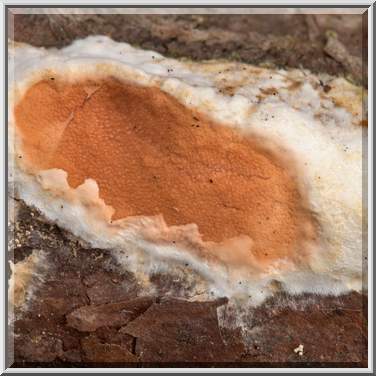
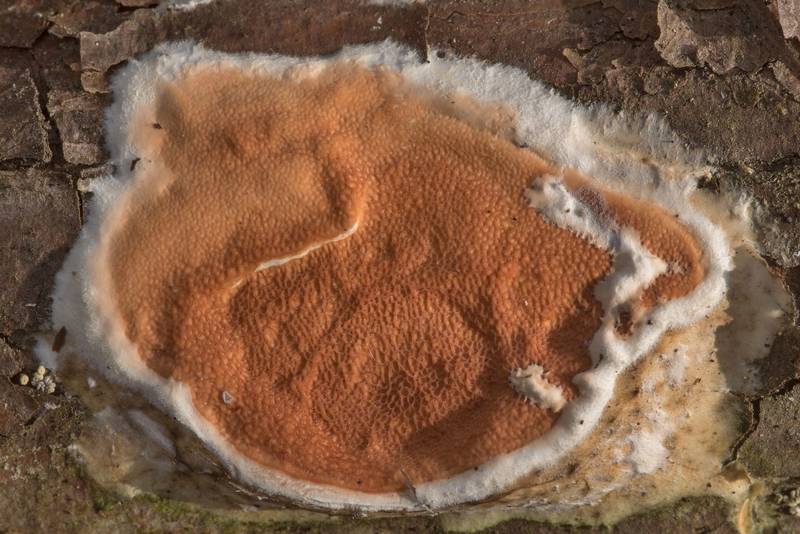
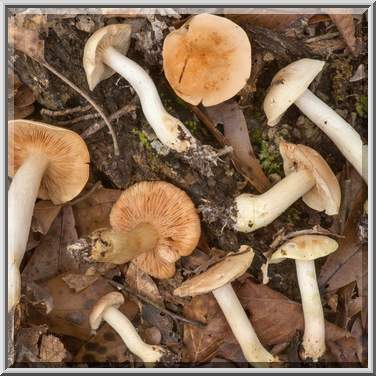
Close-up of corticioid mushroom Gloeoporus taxicola (Meruliopsis taxicola) on a fallen pine branch on South Wilderness Loop Trail at Little Lake Creek Wilderness in Sam Houston National Forest near Richards. Texas


Album 3090: Sam Houston Forest, Texas, December 26, 2021
The image presents a close-up view of the corticioid mushroom Gloeoporus taxicola (Meruliopsis taxicola) growing on a fallen pine branch along South Wilderness Loop Trail at Little Lake Creek Wilderness within Sam Houston National Forest near Richards, Texas.
**Fungal Characteristics**
* The mushroom exhibits an irregularly shaped and white to light orange-brown cap that is approximately 2-5 cm in diameter.
* A thin white or pale yellowish margin surrounds the cap, which may be somewhat darker than the rest of the fruit body.
* The underside of the cap features a network of fine, branching, whitish to pale yellowish mycelium.
**Branch Characteristics**
* The fallen pine branch is brown and has some visible cracks on its surface.
**Background and Context**
* The image provides a glimpse into the natural environment of the forest floor, with other organisms potentially present but not clearly visible in this close-up shot.
* The overall scene suggests a damp or humid microclimate that favors the growth of fungi such as Gloeoporus taxicola.
The image effectively captures the intricate details of the mushroom's morphology and its interaction with the surrounding environment. – AI vision
🇪🇸 Descripción en español / Spanish Description
En primer plano del hongo corticioide Gloeoporus taxicola (Meruliopsis taxicola) en una rama de pino caída en South Wilderness Loop Trail en Little Lake Creek Wilderness en Sam Houston National Forest cerca de Richards, Texas, el 26 de diciembre de 2021. La imagen presenta una vista de cerca del hongo corticioide Gloeoporus taxicola (Meruliopsis taxicola) que crece en una rama de pino caída a lo largo de South Wilderness Loop Trail en Little Lake Creek Wilderness dentro de Sam Houston National Forest cerca de Richards, Texas. **Características del hongo** * El hongo presenta una forma irregular y capuchón de color blanco a ligeramente anaranjado-pardo que mide aproximadamente 2-5 cm de diámetro. * Un delgado borde blanco o amarillento pálido rodea la tapa, que puede ser algo más oscura que el resto del cuerpo del fruto. * La parte inferior de la tapa presenta una red fina y ramificada de micelio blanquecino a amarillo pálido. **Características del tronco** * El tronco de pino caído es marrón y tiene grietas visibles en su superficie. **Antecedentes y contexto** * La imagen brinda una visión del entorno natural del suelo forestal, con otros organismos potencialmente presentes pero no claramente visibles en este primer plano. * La escena global sugiere un microclima húmedo o húmedo que favorece el crecimiento de hongos como Gloeoporus taxicola. La imagen captura efectivamente los detalles intrincados de la morfología del hongo y su interacción con el entorno circundante. – Spanish translation


