
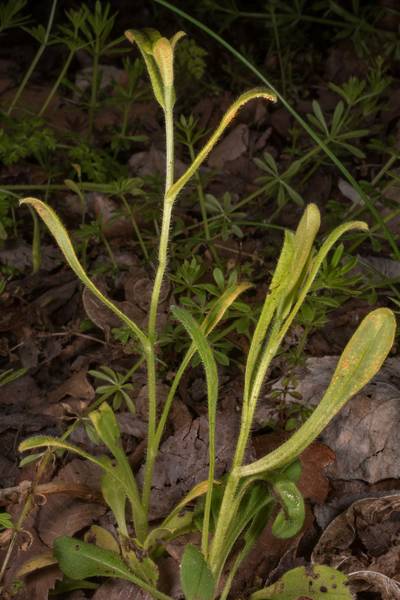

Spring scorpion grass (Myosotis macrosperma) with rust fungus Puccinia eatoniae var. myosotidis(?) at Lake Somerville Trailway near Birch Creek Unit of Somerville Lake State Park. Texas


Album 3117: Lake Somerville - College Station, Texas, March 12 - 14, 2022
The image presents a close-up view of Spring scorpion grass (Myosotis macrosperma), showcasing its distinctive characteristics and notable features.
### Plant Description
* The plant exhibits elongated, pointed leaves with serrated edges.
* Its stems are light green in color, featuring yellowish tints on the tips of the leaves and a few scattered spots near the base.
* A faint rust-colored fungus is visible along the leaf margins.
### Background and Context
* The surrounding environment appears to be a forest floor or woodland area, with brown fallen leaves covering the ground.
* Other plants are present in the background but are not clearly identifiable due to their distance from the camera.
### Caption Analysis
* The caption mentions Puccinia eatoniae var. myosotidis(?) as the rust fungus affecting the Spring scorpion grass plant.
* However, it is unclear whether this identification is definitive or tentative.
### Overall Impression
The image provides a detailed view of the Spring scorpion grass plant's physical characteristics and its interaction with the surrounding environment. The presence of the rust fungus adds an interesting element to the observation, highlighting the complex relationships between plants and their ecosystems. – AI vision
🇪🇸 Descripción en español / Spanish Description
Traduzca el siguiente texto del inglés al español:
Maleza de la escorpión de primavera (Myosotis macrosperma) con el hongo rojizo Puccinia eatoniae var. myosotidis(?) en Lake Somerville Trailway cerca de Birch Creek Unidad de Parque Estatal de Somerville Lake. Texas, 12 de marzo de 2022. La imagen presenta una vista de cerca de la maleza de la escorpión de primavera (Myosotis macrosperma), mostrando sus características distintivas y rasgos destacados. ### Descripción de plantas * La planta presenta hojas puntiagudas alargadas con bordes dentados. * Sus tallos son de color verde claro, con tonalidades amarillentas en las puntas de las hojas y algunos puntos dispersos cerca de la base. * Un hongo de color rojo pálido es visible a lo largo de los márgenes de las hojas. ### Antecedentes y contexto * El entorno circundante parece ser un suelo forestal o área boscosa, con hojas caídas marrones cubriendo el suelo. * Hay otras plantas presentes en el fondo, pero no son claramente identificables debido a su distancia de la cámara. ### Captura de pantalla Análisis * La captura de pantalla menciona Puccinia eatoniae var. Myosotidis(?) como el hongo rojizo que afecta a la planta maleza de escorpión de primavera. * Sin embargo, no está claro si esta identificación es definitiva o tentativa. ### Impresión general La imagen proporciona una vista detallada de las características físicas de la planta maleza de escorpión de primavera y su interacción con el entorno circundante. La presencia del hongo rojizo agrega un elemento interesante a la observación, destacando las complejas relaciones entre las plantas y sus ecosistemas. – Spanish translation


