
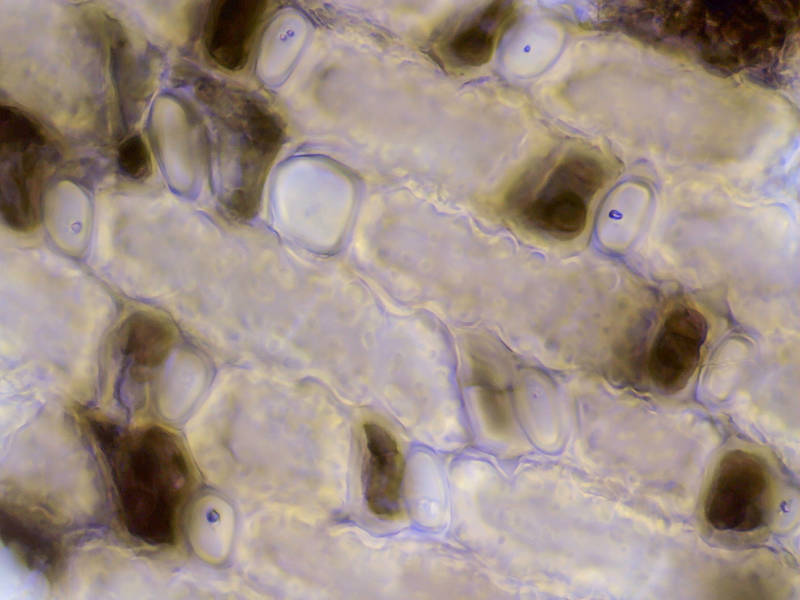

Black Ascomycota fungus and skin of giant cane under a microscope at larger magnification, collected on Kiwanis Nature Trail. College Station, Texas


Album 3123: College Station - Sam Houston Forest, Texas, April 1 - 2, 2022
The image presents a microscopic view of fungal structures embedded within plant tissue. The image's background appears to be skin from giant cane, with numerous dark-colored fungal structures scattered throughout. These structures are likely spore-bearing structures characteristic of Ascomycota fungi.
**Key Features:**
* **Fungal Structures:** The dark-colored objects visible in the image are likely the fruiting bodies or conidiophores of an Ascomycota fungus.
* **Plant Tissue:** The surrounding tissue appears to be skin from giant cane, as indicated by the caption. Giant cane is a type of grass commonly found in wetlands and along waterways.
* **Microscopic View:** The image was captured at a higher magnification than usual, allowing for a more detailed examination of the fungal structures within the plant tissue.
**Conclusion:**
The image provides a unique glimpse into the microscopic world of fungi and their interactions with plant hosts. The presence of Ascomycota fungi in giant cane skin suggests that these microorganisms play an important role in decomposing organic matter and recycling nutrients in wetland ecosystems. Further study is needed to fully understand the ecological significance of this interaction and its implications for ecosystem health. – AI vision
🇪🇸 Descripción en español / Spanish Description
El hongo ascomiceto negro y la piel del cañón gigante bajo un microscopio con mayor aumento, recogidos en el camino natural de Kiwanis. College Station, Texas, 1 de abril de 2022. La imagen presenta una vista microscópica de las estructuras fúngicas incrustadas dentro del tejido vegetal. El fondo de la imagen parece ser piel de cañón gigante, con numerosas estructuras fúngicas de color oscuro esparcidas por todo. Es probable que estas estructuras sean características de las estructuras portadoras de esporas propias de los hongos ascomicetos. **Características clave:** * **Estructuras fúngicas:** Los objetos de color oscuro visibles en la imagen son probablemente los cuerpos fructíferos o conidiophoros de un hongo Ascomycota. * **Tejido vegetal:** El tejido circundante parece ser piel de cañón gigante, como indica el subtítulo. El cañón gigante es una especie de hierba comúnmente encontrada en zonas húmedas y a lo largo de cursos de agua. * **Vista microscópica:** La imagen se capturó con un aumento mayor al habitual, lo que permite un examen más detallado de las estructuras fúngicas dentro del tejido vegetal. **Conclusión:** La imagen proporciona una visión única del mundo microscópico de los hongos y sus interacciones con plantas huéspedes. La presencia de hongos ascomicetos en la piel del cañón gigante sugiere que estos microorganismos desempeñan un papel importante en la descomposición de materia orgánica y el reciclaje de nutrientes en ecosistemas acuáticos. Se necesita un estudio más profundo para comprender completamente la importancia ecológica de esta interacción y sus implicaciones para la salud del ecosistema. – Spanish translation


