
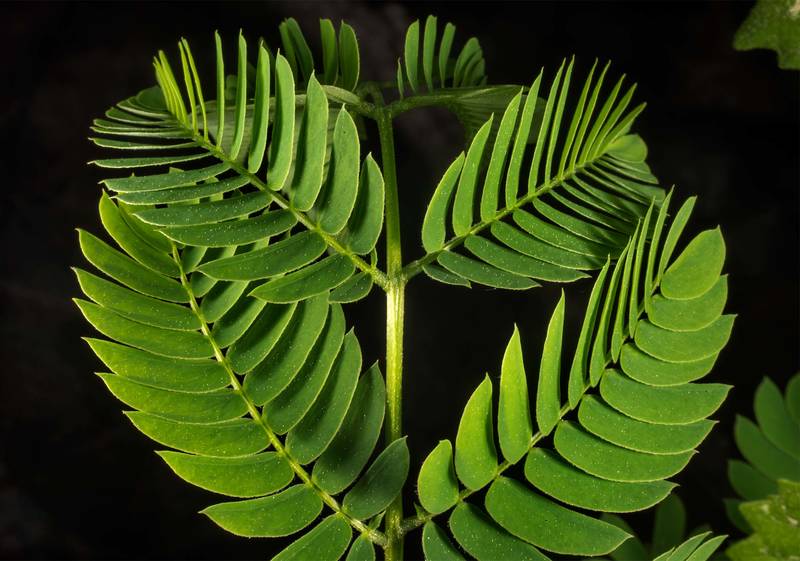

Leaves of partridge pea on North Wilderness Trail in Sam Houston National Forest near Montgomery. Texas


Album 3130: College Station - Sam Houston Forest, Texas, April 12 - 14, 2022
The image presents a detailed close-up view of two leaves from a plant identified as Partridge Pea (Chamaecrista fasciculata). The Partridge Pea is native to Central and Eastern Texas, specifically thriving in the Sam Houston National Forest near Montgomery.
**Leaf Characteristics**
* **Shape**: The leaf's shape is characterized by its bipinnately compound arrangement, featuring multiple pairs of pinnae that are further divided into smaller leaflets.
* **Color**: Both leaves exhibit a vibrant green color with a smooth texture and no visible signs of damage or disease.
* **Size**: The leaves appear relatively small in size compared to the plant's overall structure.
**Background**
The background of the image is predominantly dark, likely due to the use of shadows created by artificial light sources. This lighting technique allows for a clear focus on the leaves' details without distractions from the surrounding environment.
**Conclusion**
In summary, the provided image offers an up-close look at the distinctive bipinnately compound leaves of Partridge Pea (Chamaecrista fasciculata) in a controlled setting. The detailed view highlights the plant's unique leaf structure and coloration against a contrasting dark background. – AI vision
🇪🇸 Descripción en español / Spanish Description
Las hojas de guisante de perdiz en el North Wilderness Trail en la Sam Houston National Forest cerca de Montgomery, Texas, el 14 de abril de 2022. La imagen presenta una vista detallada y cercana de dos hojas de una planta identificada como Guisante de perdiz (Chamaecrista fasciculata). El guisante de perdiz es nativo del centro y el este de Texas, en particular, prosperando en la Sam Houston National Forest cerca de Montgomery. **Características de las hojas** * **Forma**: La forma de la hoja se caracteriza por su disposición bipinnada compuesta, con múltiples pares de pinnae que están divididas en foliolos más pequeños. * **Color**: Ambas hojas presentan un vibrante color verde con una textura lisa y sin signos visibles de daño o enfermedad. * **Tamaño**: Las hojas aparecen relativamente pequeñas en comparación con la estructura general de la planta. **Antecedentes** El fondo de la imagen es predominantemente oscuro, lo que probablemente se deba al uso de sombras creadas por fuentes de luz artificiales. Esta técnica de iluminación permite un enfoque claro sobre los detalles de las hojas sin distracciones del entorno circundante. **Conclusión** En resumen, la imagen proporcionada ofrece una vista cercana y distintiva de las hojas bipinnadamente compuestas del guisante de perdiz (Chamaecrista fasciculata) en un entorno controlado. La vista detallada destaca la estructura única de las hojas y su coloración contra un fondo oscuro contrastante. – Spanish translation


