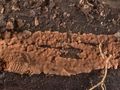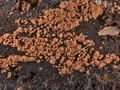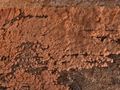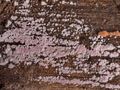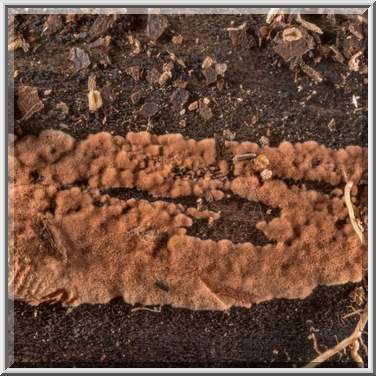
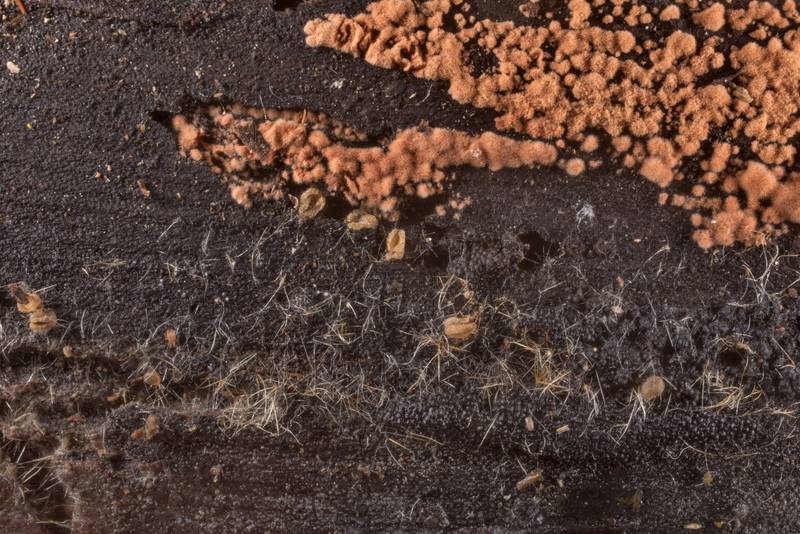
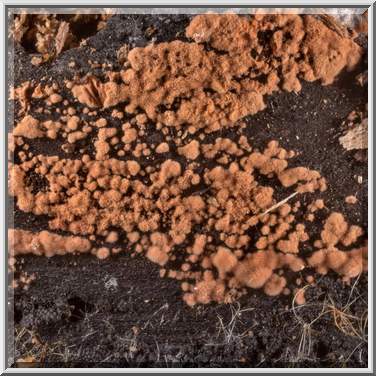
Soft brown crust fungus together with ozonium(?) on underside of an oak log in Hensel Park. College Station, Texas


Album 3140: College Station, Texas, April 28, 2022
The image depicts a close-up view of the underside of an oak log, showcasing various types of fungi and other organisms growing on its surface.
In the foreground, there are two distinct brown crusts, which appear to be made up of small, rounded clumps or nodules. These crusts have a soft, velvety texture and are likely composed of fungal mycelium (vegetative part of a fungus) that has grown together with other organic matter on the log's surface.
In the middle ground, there is what appears to be another type of fungus growing amongst the brown crusts. This organism has long, thin white filaments or hyphae that are visible against the darker background of the oak log. It may be an oomycete, a group of fungi-like organisms that have characteristics similar to those of true fungi but are more closely related to algae and protozoa.
In the background, there is some other organic matter on the surface of the log. This could include pieces of bark or other plant material that has broken off from nearby trees and fallen onto the log.
Overall, the image suggests that this oak log provides a suitable habitat for a variety of fungi and other microorganisms to grow and thrive. – AI vision
🇪🇸 Descripción en español / Spanish Description
Un hongo de corteza marrón suave junto con ozonio (?) en la cara inferior de un tronco de roble en Hensel Park. College Station, Texas, 28 de abril de 2022. La imagen representa una vista detallada de la cara inferior de un tronco de roble, que muestra varios tipos de hongos y otros organismos que crecen en su superficie. En primer plano, hay dos costras marrones distintas, que parecen estar compuestas por grupos o nódulos redondeados pequeños. Estas costras tienen una textura suave y vellosa y probablemente estén compuestas de micelio fungico (parte vegetativa de un hongo) que ha crecido junto con otra materia orgánica en la superficie del tronco. En el medio, hay lo que parece ser otro tipo de hongo creciendo entre las costras marrones. Este organismo tiene filamentos o hifas blancas largas y delgadas que son visibles contra el fondo más oscuro del tronco de roble. Puede tratarse de un oomiceto, un grupo de organismos similares a hongos que tienen características similares a las de los hongos verdaderos pero están más relacionados con las algas y los protozoos. En segundo plano, hay otra materia orgánica en la superficie del tronco. Puede incluir pedazos de corteza u otro material vegetal que se ha desprendido de árboles cercanos y ha caído sobre el tronco. En general, la imagen sugiere que este tronco de roble proporciona un hábitat adecuado para el crecimiento y desarrollo de una variedad de hongos y otros microorganismos. – Spanish translation