 |
| |||||||||||||||

| ||||||||||||||||


| Similar |   |
  |
  |
  |
  |
| |||||||||||||||||||||||||||
| |||||||||||||||||||||||||||
| 1996 1997 1998 1999 2000 2001 2002 2003 2004 2005 2006 2007 2008 2009 2010 2011 2012 2013 2014 2015 2016 2017 2018 2019 2020 2021 2022 2023 2024 2025 2026 | |||||||||||||||||||||||||||
| New version Slide Show Most Popular Full List Statistics Technical Details Home Page | |||||||||||||||||||||||||||
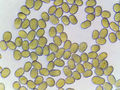
Spores of a white Amanita mushroom species were collected near Pole Creek in the Sam Houston National Forest, located north of Montgomery, Texas, on May 8th, 2022. The spores were observed to be brown in color, and no KOH or iodine solution was used for the spore print. – generated by AI |
The image shows an assortment of spores floating on a white surface or substrate. The spores are scattered throughout the frame and appear to be circular in shape. Many have a dark brown hue with lighter edges, while others display a uniform light tan color. The spore print is brown, suggesting that it was collected from a mushroom species that produces brown spores. The fact that no chemicals (KOH or iodine solution) were used on the sample implies that this particular image provides an accurate representation of the natural appearance of these spores. Given the caption's mention of "white Amanita like" mushroom, it is likely that the sample was collected from a species within the genus Amanita. This genus includes several highly poisonous and deadly mushrooms, including the death cap (Amanita phalloides), which is responsible for the majority of fatal mushroom poisonings in North America. The image provides valuable information about the morphology and coloration of these spores, which can be used to aid in their identification. However, it should be noted that relying solely on visual characteristics may not be sufficient for accurate identification, as some species within this genus have similar appearances. Therefore, it is essential to consider multiple factors, including habitat, size, shape, and any visible features such as rings or volvas, when attempting to identify these mushrooms. In conclusion, the image presents a detailed view of the spores from an Amanita-like mushroom, highlighting their unique characteristics and potential dangers associated with handling this genus. While it serves as a useful reference for identification purposes, it is crucial to exercise caution when dealing with wild mushrooms due to the risks involved in mistaking poisonous species for edible ones. – AI vision |
Las esporas de un hongo blanco parecido a Amanita sin KOH o solución de yodo (impresión de esporas marrón) recogidas un día antes cerca del arroyo Pole en la Sam Houston National Forest al norte de Montgomery, Texas, el 8 de mayo de 2022. La imagen muestra una variedad de esporas flotando sobre una superficie blanca o sustrato. Las esporas están dispersadas por todo el marco y parecen tener forma circular. Muchos tienen un matiz marrón oscuro con bordes más claros, mientras que otros muestran un color beige uniforme. La impresión de esporas es marrón, lo que sugiere que se recogió de una especie de hongo que produce esporas marronáceas. El hecho de que no se hayan usado químicos (KOH o solución de yodo) en la muestra implica que esta imagen proporciona una representación precisa del aspecto natural de estas esporas. Dado que el subtítulo menciona un hongo blanco parecido a Amanita, es probable que la muestra se recogiera de una especie dentro del género Amanita. Este género incluye varias especies altamente venenosas y mortales, incluida la campanilla mortal (Amanita phalloides), responsable de la mayoría de los envenenamientos por hongos fatales en América del Norte. La imagen proporciona información valiosa sobre la morfología y la coloración de estas esporas, que se pueden usar para ayudar en su identificación. Sin embargo, conviene tener en cuenta que depender únicamente de características visuales puede no ser suficiente para una identificación precisa, ya que algunas especies dentro de este género tienen apariencias similares. Por lo tanto, es esencial considerar múltiples factores, incluidos el hábitat, el tamaño, la forma y cualquier rasgo visible, como anillos o volvas, al intentar identificar estos hongos. En conclusión, la imagen presenta una vista detallada de las esporas de un hongo blanco parecido a Amanita, destacando sus características únicas y los peligros potenciales asociados con la manipulación de este género. Si bien sirve como referencia útil para fines de identificación, es crucial ejercer cautela al tratar con hongos silvestres debido a los riesgos implicados en confundir especies venenosas con comestibles. – Spanish translation |
Keyword variants
microscopy
micrograph
Houston National Forest picture gallery
high resolution online digital collection
Lone Star State
United States
photo album
documentary photographs
daily pics
TX
travelogue
snapshots
sightseeing
photowalks
photoblog
graphic
fungus
fungi
fotografias
foto
America