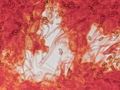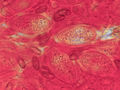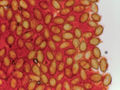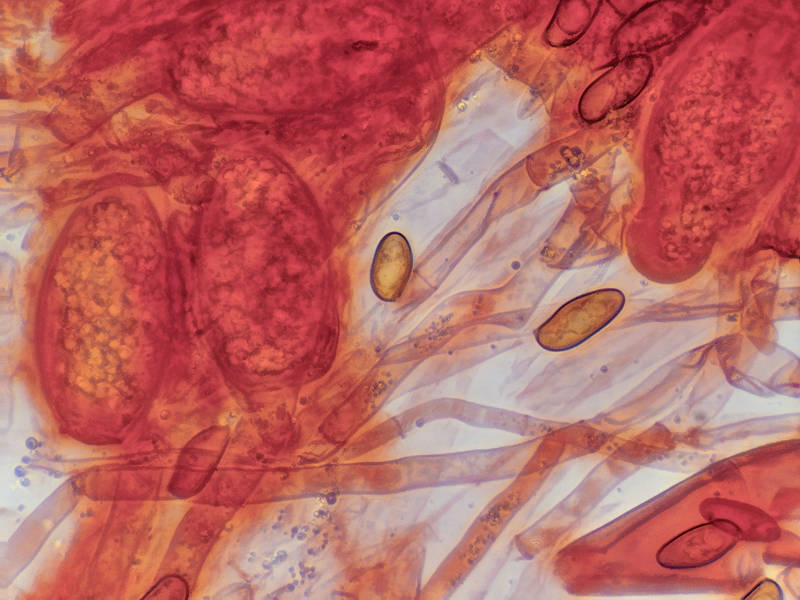

Small orange cap bolete mushroom Boletus subfraternus infected by Hypomyces fungus in Congo Red solution under a microscope, collected in Sam Houston National Forest near Montgomery. Texas


Album 3171: Sam Houston Forest, Texas, June 6, 2022
The image presents a microscopic view of a small orange cap bolete mushroom (Boletus subfraternus) infected by the Hypomyces fungus, treated with Congo Red solution.
**Key Features:**
* **Mushroom Cap:** The mushroom's cap appears as an irregularly shaped, rounded structure with a rough texture.
* **Fungal Infection:** The surface of the cap is covered in a layer of fungal hyphae, which are long, branching filaments that give the appearance of a thick, fuzzy coat. These hyphae have penetrated the mushroom's tissue and are causing damage to its cells.
* **Congo Red Solution:** The use of Congo Red solution highlights the presence of beta-pleated sheets in the fungal structure. This is characteristic of amyloid fibrils, which are protein structures that can be indicative of certain types of infections or diseases.
**Conclusion:**
The image suggests that the mushroom has been infected by a type of fungus that produces amyloid fibrils, potentially indicating a disease or infection affecting the mushroom's cells. The use of Congo Red solution to visualize these fibrils is a common technique used in microscopy to detect specific types of proteins and structures within biological samples. – AI vision
🇪🇸 Descripción en español / Spanish Description
Un hongo capuchino pequeño (Boletus subfraternus) infectado por el hongo Hypomyces en una solución de rojo Congo bajo un microscopio, recogido en la Sam Houston National Forest cerca de Montgomery, Texas, el 6 de junio de 2022. La imagen presenta una vista microscópica de un hongo capuchino pequeño (Boletus subfraternus) infectado por el hongo Hypomyces, tratado con solución de rojo Congo. **Características clave:** * **Tapas del hongo:** La parte superior del hongo se muestra como una estructura redondeada de forma irregular con una textura áspera. * **Infección fúngica:** La superficie de la tapa está cubierta por una capa de hifas fúngicas, filamentos largos y ramificados que dan la apariencia de un revestimiento espeso y peludo. Estas hifas han penetrado el tejido del hongo y están causando daños a sus células. * **Solución de rojo Congo:** El uso de una solución de rojo Congo pone de manifiesto la presencia de láminas beta en la estructura fúngica. Esto es característico de las fibrillas amiloides, que son estructuras proteicas que pueden ser indicativas de ciertos tipos de infecciones o enfermedades. **Conclusión:** La imagen sugiere que el hongo ha sido infectado por un tipo de hongo que produce fibrillas amiloides, lo que indica potencialmente una enfermedad o infección que afecta las células del hongo. El uso de una solución de rojo Congo para visualizar estas fibrillas es una técnica común utilizada en microscopía para detectar tipos específicos de proteínas y estructuras dentro de muestras biológicas. – Spanish translation