
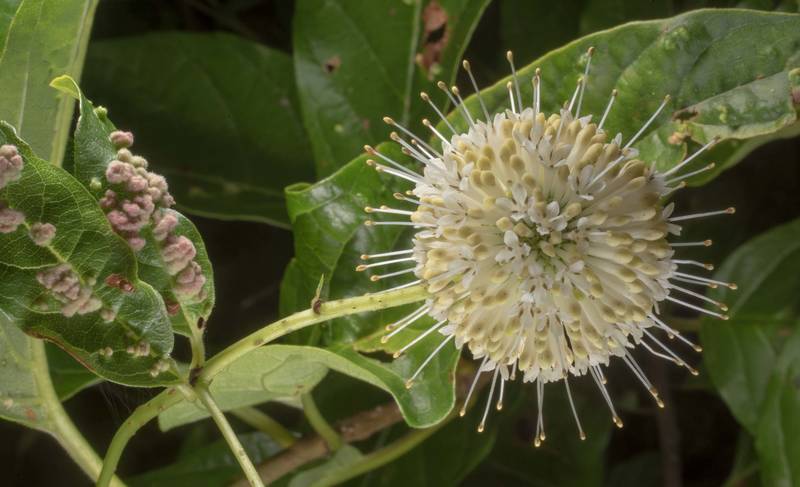

Buttonbush with leaf galls caused by mites Aceria cephalanthi in Watson Rare Native Plant Preserve. Warren, Texas


Album 3182: Watson Rare Native Plant Preserve, Warren, June 25, 2022
The image presents a close-up view of a buttonbush plant (Cephalanthus occidentalis) with leaf galls caused by mites (Aceria cephalanthi). The photograph is divided into two sections: a detailed shot of the leaf gall on the upper left, and an overall view of the buttonbush in bloom.
**Upper Left Section**
* **Leaf Gall:** A cluster of small, rounded bumps are visible on the edge of a dark green leaf. These bumps are approximately 1-2 millimeters in diameter and appear to be caused by tiny mites.
* **Gall Structure:** The galls are irregularly shaped and have a rough texture. They are lighter in color than the surrounding leaf tissue, suggesting that they may be composed of different materials or have undergone some kind of cellular transformation.
**Overall View**
* **Buttonbush Bloom:** In the center-right of the image, a white flower with long stamens protrudes from the tip of a green stem. The petals are not visible, but the stamens are prominent and give the flower a distinctive appearance.
* **Leaf Structure:** The leaves surrounding the gall appear to be healthy, with no signs of damage or disease. They have a smooth texture and a glossy appearance, suggesting that they may be well-watered and receiving adequate nutrients.
**Background**
* **Plant Structure:** In the background, additional branches and stems of the buttonbush plant are visible, along with other leaves and flowers. The overall structure of the plant appears to be robust, with many branches and stems supporting a large number of blooms.
* **Environmental Context:** Although not explicitly stated in the caption, it can be inferred that the image was taken outdoors, possibly in a garden or natural setting. The presence of sunlight and shadows suggests that the photo was taken during daylight hours.
**Additional Observations**
* **Mite Presence:** The mites causing the leaf gall are likely tiny arthropods that feed on plant sap, leading to the formation of galls as a defense mechanism.
* **Gall Function:** The galls may serve as a refuge for the mites or provide them with additional nutrients. They can also affect the plant's growth and development by altering its nutrient uptake and water transport.
In summary, the image captures a buttonbush plant with leaf galls caused by mites, providing a detailed view of both the affected area and the overall structure of the plant. The presence of these galls highlights the complex relationships between plants and their associated organisms in natural ecosystems. – AI vision
🇪🇸 Descripción en español / Spanish Description
El botón de arbusto con agallas foliares causadas por ácaros Aceria cephalanthi en la reserva de plantas nativas raras de Watson. Warren, Texas, 25 de junio de 2022. La imagen presenta una vista detallada de una planta de botón (Cephalanthus occidentalis) con agallas foliares causadas por ácaros (Aceria cephalanthi). La fotografía se divide en dos secciones: una toma detallada de la agalla foliar en la esquina superior izquierda, y una vista general del botón arbusto en flor. **Sección superior izquierda** * **Agalla Foliar:** Un grupo de pequeñas protuberancias redondas son visibles en el borde de una hoja verde oscuro. Estas protuberancias tienen aproximadamente 1-2 milímetros de diámetro y parecen estar causadas por ácaros minúsculos. * **Estructura de la agalla:** Las agallas son de forma irregular y tienen una textura rugosa. Son más claras que el tejido de las hojas circundante, lo que sugiere que pueden estar compuestas por diferentes materiales o haber sufrido algún tipo de transformación celular. **Vista General** * **Botón arbusto en flor:** En la esquina inferior derecha de la imagen, un flor blanca con largos estambres sobresale de la punta de un tallo verde. No son visibles los pétalos, pero los estambres tienen una apariencia distintiva y dan a la flor un aspecto prominente. * **Estructura de las hojas:** Las hojas que rodean la agalla parecen sanas, sin signos de daño o enfermedad. Tienen una textura lisa y un aspecto brillante, lo que sugiere que pueden estar bien regadas y recibiendo los nutrientes adecuados. **Fondo** * **Estructura de la planta:** En el fondo, son visibles ramas y tallos adicionales de la planta de botón arbusto, junto con otras hojas y flores. La estructura general de la planta parece robusta, con muchas ramas y tallos que sostienen un gran número de flores. * **Contexto ambiental:** Aunque no se menciona explícitamente en la leyenda, puede inferirse que la imagen se tomó al aire libre, posiblemente en un jardín o entorno natural. La presencia de luz solar y sombras sugiere que la foto fue tomada durante el día. **Observaciones adicionales** * **Presencia de ácaros:** Es probable que los ácaros causantes de las agallas foliares sean artrópodos minúsculos que se alimentan de savia vegetal, lo que conduce a la formación de agallas como mecanismo de defensa. * **Función de la agalla:** Las agallas pueden servir de refugio para los ácaros o proporcionarles nutrientes adicionales. También pueden afectar el crecimiento y desarrollo de la planta alterando su absorción de nutrientes y transporte de agua. En resumen, la imagen captura un arbusto botón con agallas foliares causadas por ácaros, proporcionando una vista detallada tanto del área afectada como de la estructura general de la planta. La presencia de estas agallas destaca las complejas relaciones entre plantas y sus organismos asociados en los ecosistemas naturales. – Spanish translation


