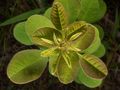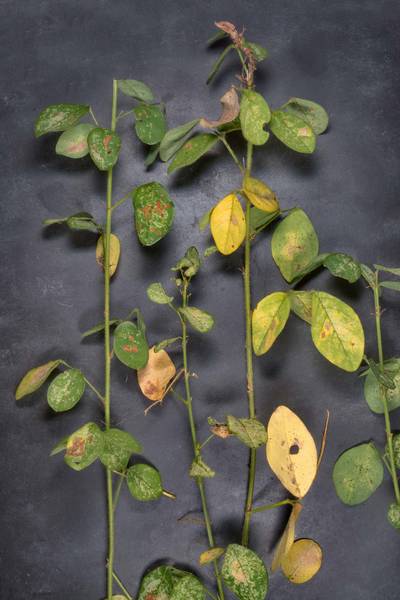

Hairy bush clover (Lespedeza hirta) with rust fungus Uromyces lespedezae or may be Cercospora on Richards Loop Trail in Sam Houston National Forest. Texas


Album 3189: Sam Houston Forest - College Station, Texas, July 10 - 12, 2022
The image depicts a plant with green leaves, some of which are yellowing and have brown spots. The stems appear healthy, indicating that the plant is not suffering from any significant nutrient deficiencies or water stress issues. However, there is evidence of fungal infection on several leaves.
**Key Observations:**
* **Leaf Coloration:** Some leaves exhibit a mix of green and yellow hues, while others display more pronounced yellowing.
* **Brown Spots:** A few leaves feature brown spots, suggesting the presence of a pathogen or disease affecting the plant's health.
* **Stem Health:** The stems appear to be in good condition, with no visible signs of damage or decay.
**Conclusion:**
Based on these observations, it is likely that the plant is infected by either Uromyces lespedezae or Cercospora. These fungal pathogens are common causes of leaf discoloration and spotting in plants. Further examination or analysis would be necessary to confirm the exact cause of the symptoms observed.
**Answer:** The image shows a hairy bush clover (Lespedeza hirta) with rust fungus Uromyces lespedezae or may be Cercospora on Richards Loop Trail in Sam Houston National Forest, Texas. – AI vision
🇪🇸 Descripción en español / Spanish Description
El arbusto de trebol peludo (Lespedeza hirta) con el hongo rojizo Uromyces lespedezae o puede ser Cercospora en el sendero Richards Loop en la Sam Houston National Forest. Texas, 10 de julio de 2022. La imagen representa una planta con hojas verdes, algunas de las cuales se están amarilleando y tienen manchas marrones. Los tallos parecen sanos, lo que indica que la planta no padece ninguna deficiencia nutricional significativa ni problemas de estrés hídrico. Sin embargo, hay evidencias de infección fúngica en varias hojas. **Observaciones clave:** * **Coloración de las hojas:** Algunas hojas muestran una mezcla de tonos verdes y amarillos, mientras que otras presentan un amarilleo más pronunciado. * **Manchas marrones:** Unas pocas hojas presentan manchas marrones, lo que sugiere la presencia de un patógeno o enfermedad que afecta la salud de la planta. * **Salud del tallo:** Los tallos parecen estar en buenas condiciones, sin signos visibles de daño o descomposición. **Conclusión:** Basándonos en estas observaciones, es probable que la planta esté infectada por Uromyces lespedezae o Cercospora. Estos patógenos fúngicos son las causas más comunes de decoloración y manchas en las hojas de las plantas. Sería necesario un análisis o examen adicional para confirmar la causa exacta de los síntomas observados. **Respuesta:** La imagen muestra un arbusto de trebol peludo (Lespedeza hirta) con el hongo rojizo Uromyces lespedezae o puede ser Cercospora en el sendero Richards Loop en la Sam Houston National Forest, Texas. – Spanish translation