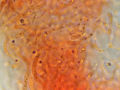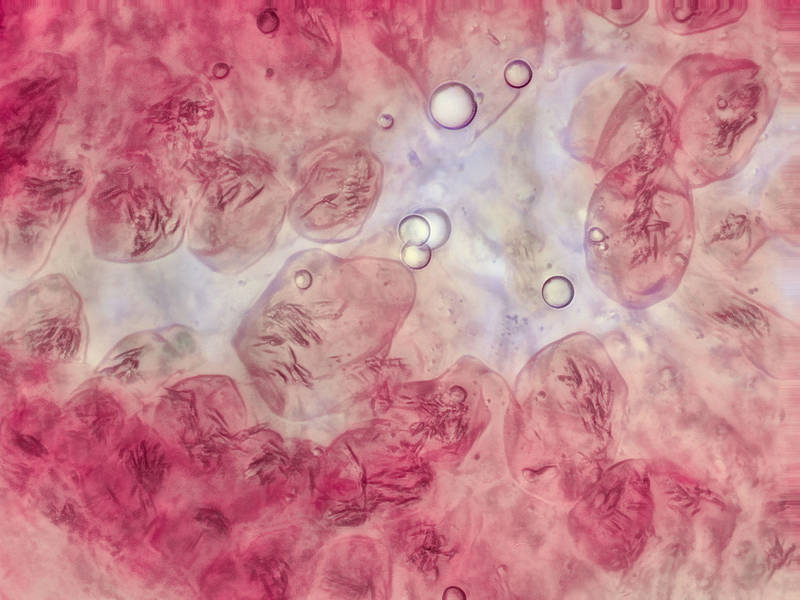

Gall fungus Botryosphaeria dothidea (in Congo Red solution) collected from leaf tar spots on goldenrod on Richards Loop Trail in Sam Houston National Forest. Texas


Album 3189: Sam Houston Forest - College Station, Texas, July 10 - 12, 2022
The image is a microscopic view of a fungal structure, specifically Botryosphaeria dothidea, which causes gall fungus and leaf tar spots on goldenrod plants. The fungus appears as numerous small, oval-shaped structures with ridged surfaces, resembling tiny, irregularly shaped eggs or ovoids.
These structures are likely the fruiting bodies of the fungus, responsible for producing spores that can infect other plants. The image suggests that the fungus has been growing in a dense cluster, possibly on the surface of an infected leaf or stem.
The use of Congo Red solution to stain the fungus indicates that it is being examined under a microscope for diagnostic purposes. Congo Red is a dye commonly used in histology and microbiology to visualize fungal structures and other microorganisms.
Overall, the image provides valuable information about the morphology and growth patterns of Botryosphaeria dothidea, which can be useful for identifying and studying this pathogen. – AI vision
🇪🇸 Descripción en español / Spanish Description
Hongo de las yemas (Botryosphaeria dothidea) (en solución de Rojo Congo) recogido en manchas de brea foliar en solidago en el sendero Richards Loop de la Sam Houston National Forest, Texas. 10 de julio de 2022. La imagen es una vista microscópica de una estructura fúngica, específicamente Botryosphaeria dothidea, que causa hongos de las yemas y manchas de brea foliar en plantas de solidago. El hongo aparece como numerosas estructuras ovaladas con superficies arrugadas, similares a huevos irregularmente formados o huevos ovoides pequeños. Es probable que estas estructuras sean los cuerpos fructíferos del hongo, responsables de producir esporas que pueden infectar otras plantas. La imagen sugiere que el hongo ha estado creciendo en un grupo denso, posiblemente sobre la superficie de una hoja o tallo infectado. El uso de solución de Rojo Congo para teñir el hongo indica que se está examinando bajo un microscopio con fines de diagnóstico. El Rojo Congo es un colorante comúnmente utilizado en histología y microbiología para visualizar estructuras fúngicas y otros microorganismos. En general, la imagen proporciona información valiosa sobre la morfología y los patrones de crecimiento de Botryosphaeria dothidea, que pueden ser útiles para identificar y estudiar este patógeno. – Spanish translation