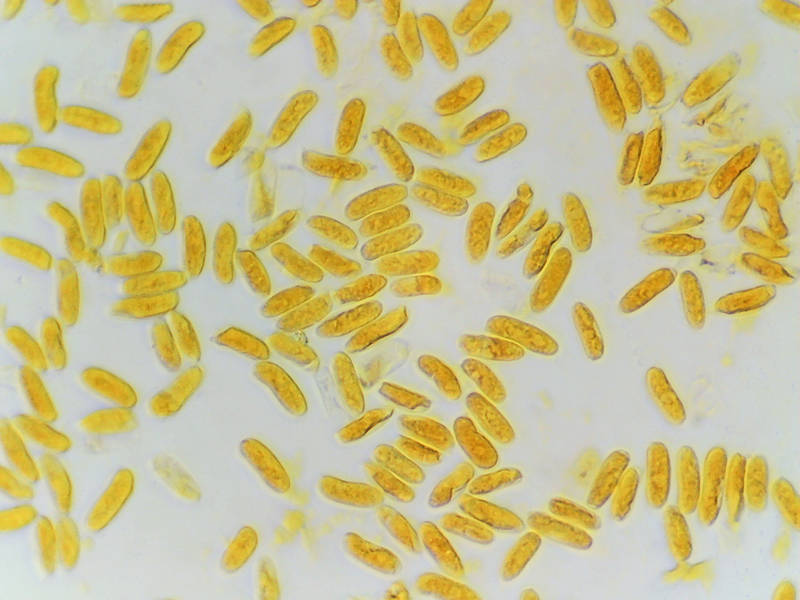

Spores of white resupinate polypore mushroom from bark of a fallen pine branch, collected 2 days before near Caney Creek in Sam Houston National Forest near Montgomery. Texas


Album 3196: Sam Houston Forest - Calvert, Texas, July 23 - 25, 2022
The image depicts a collection of tiny yellowish spores scattered across a plain white background. The spores are long and oval-shaped, with rounded ends, and appear to be randomly arranged.
Based on the provided information, it is likely that these spores belong to a type of fungus, specifically a resupinate polypore mushroom, which is commonly found growing on tree bark. Resupinate fungi have their fruiting bodies lying flat against the substrate, rather than standing upright like other types of mushrooms.
The fact that the spores were collected from a fallen pine branch suggests that they may be associated with this type of tree or its environment. The collection date and location also provide context for understanding the habitat and ecological conditions in which these fungi might thrive.
Overall, the image provides a detailed view of the microscopic structure of fungal spores, highlighting their unique shape and arrangement on the surface. This level of detail can be useful for identifying and classifying different species of fungi based on their physical characteristics. – AI vision
🇪🇸 Descripción en español / Spanish Description
Se observan esporas del hongo blanco resupinado de poliporo en la corteza de un ramal caído de pino, recogido dos días antes cerca de Caney Creek en el Bosque Nacional Sam Houston cerca de Montgomery. Texas, 25 de julio de 2022. La imagen muestra una colección de pequeñas esporas amarillentas dispersas sobre un fondo blanco uniforme. Las esporas son largas y ovaladas, con extremos redondeados, y parecen estar dispuestas aleatoriamente. En base a la información proporcionada, es probable que estas esporas pertenezcan a un tipo de hongo, específicamente un hongo resupinado de poliporo, que se encuentra comúnmente creciendo sobre la corteza de los árboles. Los hongos resupinados tienen sus cuerpos fructíferos acostados planos contra el sustrato, en lugar de erguidos como otros tipos de hongos. El hecho de que las esporas se recolectaran de un ramal caído de pino sugiere que pueden estar asociadas con este tipo de árbol o con su entorno. La fecha y ubicación de la colección también proporcionan contexto para comprender el hábitat y las condiciones ecológicas en las que estos hongos pueden prosperar. En general, la imagen proporciona una vista detallada de la estructura microscópica de las esporas fúngicas, destacando su forma única y disposición sobre la superficie. Este nivel de detalle puede ser útil para identificar y clasificar diferentes especies de hongos en función de sus características físicas. – Spanish translation