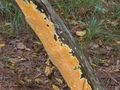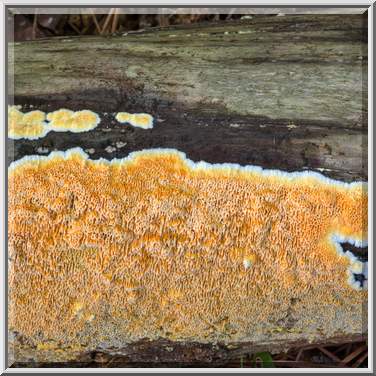
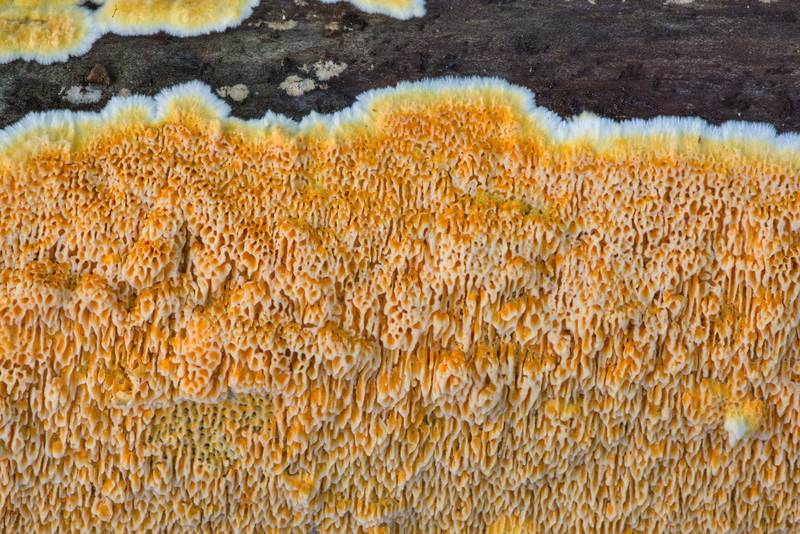
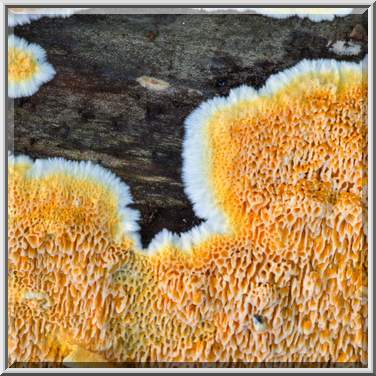
Orange resupinate polypore mushroom Fibroporia radiculosa on side surface of a pine log without bark on Caney Creek Trail (Little Lake Creek Loop Trail) in Sam Houston National Forest north from Montgomery. Texas


Album 3210: Sam Houston Forest - College Station, Texas, August 14 - 15, 2022
The image presents a close-up view of an orange resupinate polypore mushroom, specifically Fibroporia radiculosa, growing on the side surface of a pine log without bark. This type of mushroom is characterized by its unique growth pattern and coloration.
* **Mushroom Appearance:**
* The mushroom has a vibrant orange hue with white edges.
* It exhibits a resupinate growth habit, meaning it grows flat against the substrate rather than forming a stem or cap.
* The surface of the mushroom is covered in small, branching tendrils that resemble coral or a network of fine fibers.
* **Growth Environment:**
* The mushroom is growing on the side surface of a pine log without bark.
* This suggests that the mushroom has colonized the decaying wood of the pine tree.
* **Background and Context:**
* The background of the image appears to be the dark, rough texture of the pine log.
* There are no other visible organisms or features in the immediate vicinity of the mushroom.
In summary, the image showcases a vibrant orange resupinate polypore mushroom growing on the side surface of a pine log without bark. The mushroom's unique appearance and growth habit suggest that it is well adapted to its environment and plays an important role in decomposing organic matter in forest ecosystems. – AI vision
🇪🇸 Descripción en español / Spanish Description
El hongo de color naranja resupinado Fibroporia radiculosa en la superficie lateral de un tronco de pino sin corteza en el Sendero Caney Creek (Sendero del Bucle del Arroyo Little Lake) en el Bosque Nacional Sam Houston al norte de Montgomery. Texas, 14 de agosto de 2022. La imagen presenta una vista detallada de un hongo de poliporo resupinado de color naranja, específicamente Fibroporia radiculosa, creciendo en la superficie lateral de un tronco de pino sin corteza. Este tipo de hongo se caracteriza por su único patrón de crecimiento y coloración.
**Apariencia del hongo:** * El hongo tiene una vibrante tonalidad naranja con bordes blancos. * Muestra un hábitat de crecimiento resupinado, lo que significa que crece plano contra el sustrato en lugar de formar un tallo o una tapa. * La superficie del hongo está cubierta por pequeños y ramificados tentáculos que recuerdan a corales o a redes de fibras finas. *
**Entorno de crecimiento:** * El hongo está creciendo en la superficie lateral de un tronco de pino sin corteza. * Esto sugiere que el hongo ha colonizado la madera en descomposición del árbol de pino. * **Antecedentes y contexto:** * Los antecedentes de la imagen parecen ser la textura oscura y rugosa del tronco de pino. * No hay otros organismos visibles ni características en las inmediaciones del hongo.
En resumen, la imagen muestra un vibrante hongo de poliporo resupinado de color naranja creciendo en la superficie lateral de un tronco de pino sin corteza. La única apariencia y hábitat de crecimiento del hongo sugieren que está bien adaptado a su entorno y desempeña un papel importante en la descomposición de la materia orgánica en los ecosistemas forestales. – Spanish translation