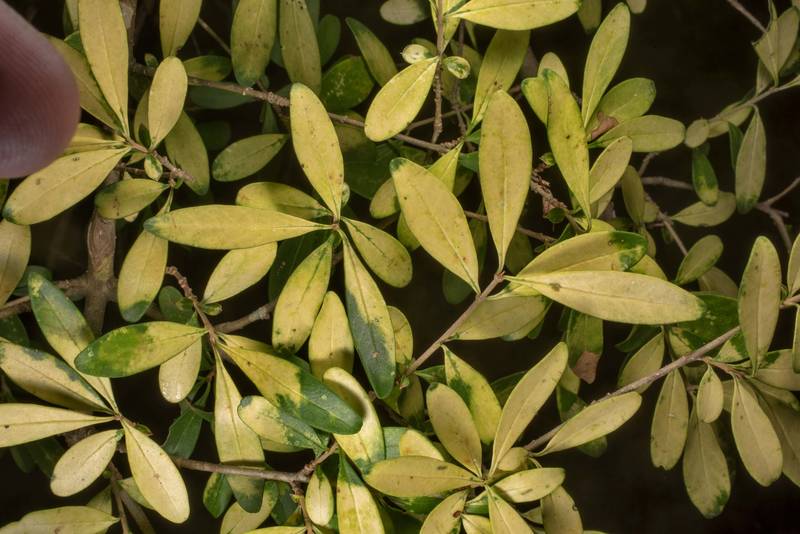

Chlorosis (loss of the normal green coloration) of leaves of Chinese privet in David E. Schob Nature Preserve at 906 Ashburn St. College Station, Texas


Album 3249: College Station - Sam Houston Forest, Texas, September 22 - 24, 2022
The image shows a close-up view of the leaves of a Chinese privet plant, which is exhibiting chlorosis (loss of normal green coloration). The leaves are pale yellow-green with darker green splotches, indicating that they have been affected by chlorosis.
* **Leaf Color:**
* Pale yellow-green
* Darker green splotches
* **Leaf Shape and Size:**
* Oblong or elliptical shape
* Pointed tip
* Smooth edges
* Medium to large size (about 2-3 inches long)
* **Stem Color and Texture:**
* Brownish-gray color
* Thin, smooth texture
* **Background:**
* Dark gray or black background
The image suggests that the Chinese privet plant is experiencing chlorosis, which can be caused by various factors such as nutrient deficiencies, soil pH imbalance, or root damage. The pale yellow-green leaves with darker green splotches are a common symptom of this condition.
In summary, the image shows a close-up view of the leaves of a Chinese privet plant that has been affected by chlorosis. The leaves have a pale yellow-green color with darker green splotches and exhibit an oblong or elliptical shape, pointed tip, smooth edges, and medium to large size. – AI vision
🇪🇸 Descripción en español / Spanish Description
Translating to Spanish:
Clorosis (pérdida del color verde normal) de las hojas del mirto chino en el David E. Schob Nature Preserve en 906 Ashburn Street. College Station, Texas, 22 de septiembre de 2022. La imagen muestra una vista detallada de las hojas de una planta de mirto chino, que presenta clorosis (pérdida del color verde normal). Las hojas son de un amarillo pálido con manchas verdosas más oscuras, lo que indica que han sido afectadas por la clorosis. * **Color de las hojas:** * Amarillo pálido * Manchas verdes más oscuras * **Forma y tamaño de las hojas:** * Forma ovalada o elíptica * Puntera puntiaguda * Bordes lisos * Tamaño medio a grande (aproximadamente 2-3 pulgadas de largo) * **Color y textura del tallo:** * Color gris parduzco * Textura fina y suave * **Contexto:** * Fondo gris oscuro o negro * La imagen sugiere que la planta de mirto chino está experimentando clorosis, lo cual puede ser causado por diversos factores como deficiencias nutricionales, desequilibrio del pH del suelo o daño en las raíces. Las hojas amarillo pálido con manchas verdes más oscuras son un síntoma común de esta afección. En resumen, la imagen muestra una vista detallada de las hojas de una planta de mirto chino que ha sido afectada por clorosis. Las hojas tienen un color amarillo pálido con manchas verdes más oscuras y exhiben una forma ovalada o elíptica, punta puntiaguda, bordes lisos y tamaño medio a grande (aproximadamente 2-3 pulgadas de largo). – Spanish translation