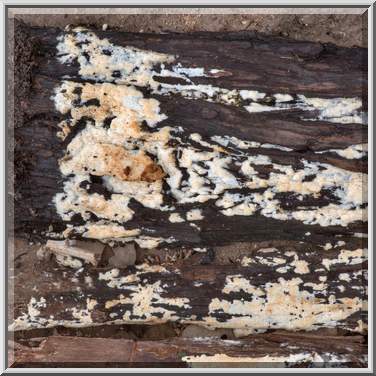
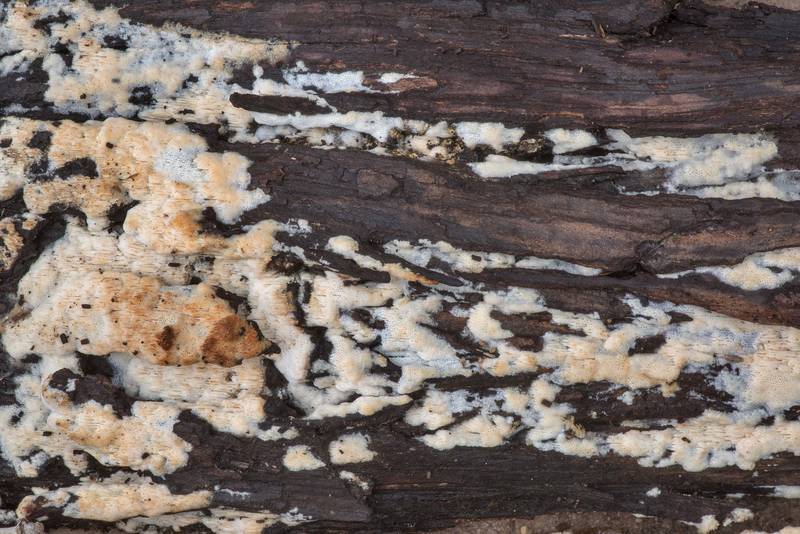
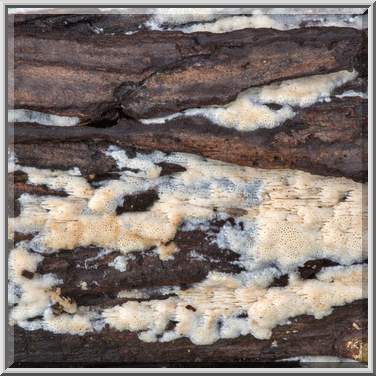
White resupinate polypore mushroom at the base of a dried red cedar (juniper tree) at Lake Somerville Trailway near Birch Creek Unit of Somerville Lake State Park. Texas


Album 3312: Lake Somerville, Texas, January 1, 2023
The image showcases a close-up view of the underside or base of a dried red cedar (juniper tree) trunk at the Lake Somerville Trailway near Birch Creek Unit of Somerville Lake State Park in Texas. The surface is predominantly dark brown and features numerous white patches that appear to be irregularly shaped, with some resembling small clouds.
Upon closer inspection, it becomes apparent that these patches are actually a type of mushroom, specifically white resupinate polypore mushrooms. These mushrooms are characterized by their thin, flat growth habit and are often found on the underside of decaying wood. They play an important role in the decomposition process, breaking down organic matter and recycling nutrients.
The presence of these mushrooms on the base of a dried red cedar trunk suggests that the tree has undergone significant decay or rotting over time. This is not unusual for trees that have reached maturity and are nearing the end of their lifespan.
Overall, the image provides valuable insight into the fascinating world of fungi and their role in shaping our natural environment. By studying these organisms and their interactions with other living things, we can gain a deeper appreciation for the complex ecosystems that surround us. – AI vision
🇪🇸 Descripción en español / Spanish Description
Hongo poliporo blanco en el lado inferior de un cedro seco (cedro rojo) junto al Lake Somerville Trailway cerca de la Unidad Birch Creek del Parque Estatal Somerville Lake. Texas, enero 1, 2023. La imagen muestra una vista de cerca del lado inferior o base de un tronco de cedro seco (cedro rojo) en el Lake Somerville Trailway cerca de la Unidad Birch Creek del Parque Estatal Somerville Lake en Texas. El color predominante de la superficie es marrón oscuro y presenta numerosas manchas blancas que parecen tener formas irregulares, algunas de las cuales se asemejan a pequeñas nubes. Al inspeccionarlo más de cerca, se puede apreciar que estas manchas son en realidad un tipo de hongo, específicamente hongos poliporos resupinados blancos. Estos hongos se caracterizan por su hábitat delgado y plano y se encuentran a menudo en el lado inferior de madera en descomposición. Desempeñan un papel importante en el proceso de descomposición, descomponiendo materia orgánica y reciclando nutrientes. La presencia de estos hongos en la base del tronco de un cedro seco sugiere que el árbol ha experimentado una importante putrefacción o podredumbre a lo largo del tiempo. Esto no es inusual para los árboles que han alcanzado la madurez y están llegando al final de su ciclo vital. En general, la imagen proporciona una valiosa visión del fascinante mundo de los hongos y su papel en conformar nuestro entorno natural. Al estudiar estos organismos y sus interacciones con otros seres vivos, podemos apreciar más profundamente los complejos ecosistemas que nos rodean. – Spanish translation


