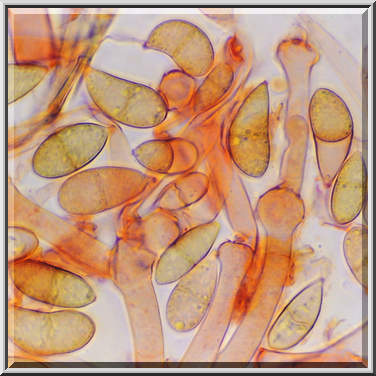
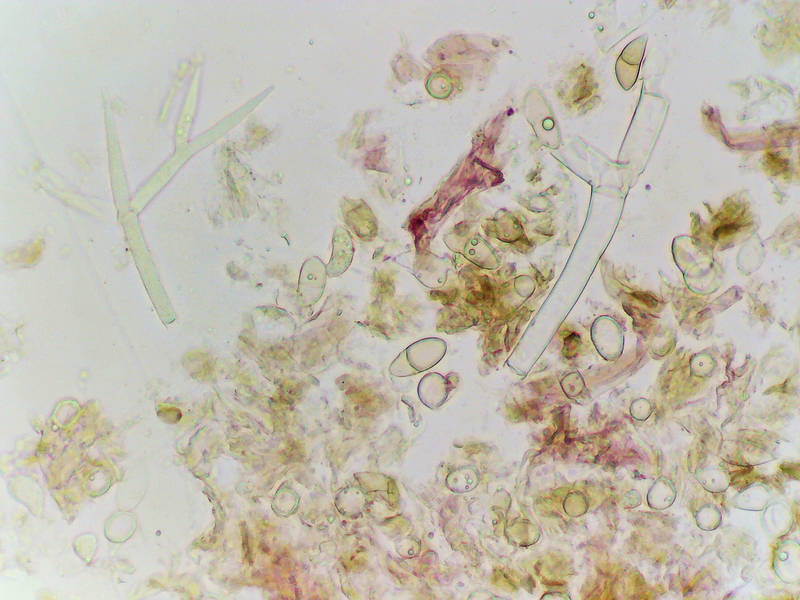

Pinkish tissue (at low magnification) of mold fungus Hypomyces from blushing bracket mushrooms, collected on Caney Creek section of Lone Star Hiking Trail in Sam Houston National Forest north from Montgomery. Texas


Album 3332: Sam Houston Forest, Texas, January 22, 2023
The image displays a microscopic view of mold fungus Hypomyces, likely found within blushing bracket mushrooms (Ganoderma applanatum). The sample appears to be stained with lactophenol cotton blue or lactophenol aniline blue, common dyes used in microscopy to visualize fungi.
The field of view is approximately 200 micrometers wide and consists of a pinkish background punctuated by green and purple specks that could represent spores or fungal hyphae. The image does not provide enough information to definitively determine the identity of the sample, but it appears to be a type of mold fungus.
The microscopic analysis suggests that the sample is composed of various structures such as hyphae, spores, and possibly mycelium. These components are characteristic features of fungi, which are typically multicellular organisms with a vegetative part called mycelium and reproductive parts known as fruiting bodies or sporangia.
In this image, the pinkish background represents the substrate (in this case likely the blushing bracket mushroom), while the green and purple specks represent fungal structures such as spores, hyphae, or mycelium.
Overall, based on the microscopic analysis and the provided caption, it appears that the sample is a type of mold fungus Hypomyces found within blushing bracket mushrooms. – AI vision
🇪🇸 Descripción en español / Spanish Description
Tejido rosado (a baja ampliación) del hongo moho Hypomyces de los hongos del género Ganoderma applanatum, recogidos en la sección Caney Creek del Lone Star Hiking Trail en el Bosque Nacional Sam Houston al norte de Montgomery. Texas, 22 de enero de 2023. La imagen muestra una vista microscópica del hongo moho Hypomyces, probablemente encontrado dentro de los hongos Ganoderma applanatum. La muestra parece teñida con lazufre-azul o azul-lactofenol anilina, colorantes comunes utilizados en microscopía para visualizar hongos. El campo de visión mide aproximadamente 200 micrómetros de ancho y consiste en un fondo rosado punteado por manchas verdes y moradas que podrían representar esporas u hifas fúngicas. La imagen no proporciona información suficiente para determinar definitivamente la identidad de la muestra, pero parece ser un tipo de hongo moho. El análisis microscópico sugiere que la muestra está compuesta por varias estructuras como hifas, esporas y posiblemente micelio. Estos componentes son característicos de los hongos, que generalmente son organismos multicelulares con una parte vegetativa llamada micelio y partes reproductivas conocidas como cuerpos fructíferos o esporangios. En esta imagen, el fondo rosado representa al sustrato (en este caso probablemente el hongo del género Ganoderma applanatum), mientras que las manchas verdes y moradas representan estructuras fúngicas como esporas, hifas o micelio. En general, en base al análisis microscópico y la legenda proporcionada, parece que la muestra es un tipo de hongo moho Hypomyces encontrado dentro de los hongos Ganoderma applanatum. – Spanish translation


