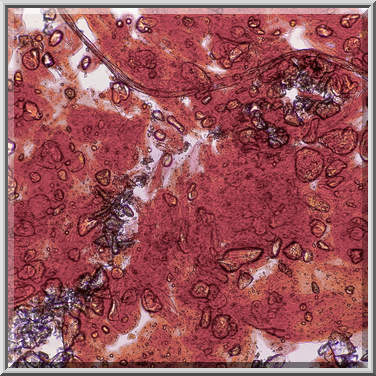
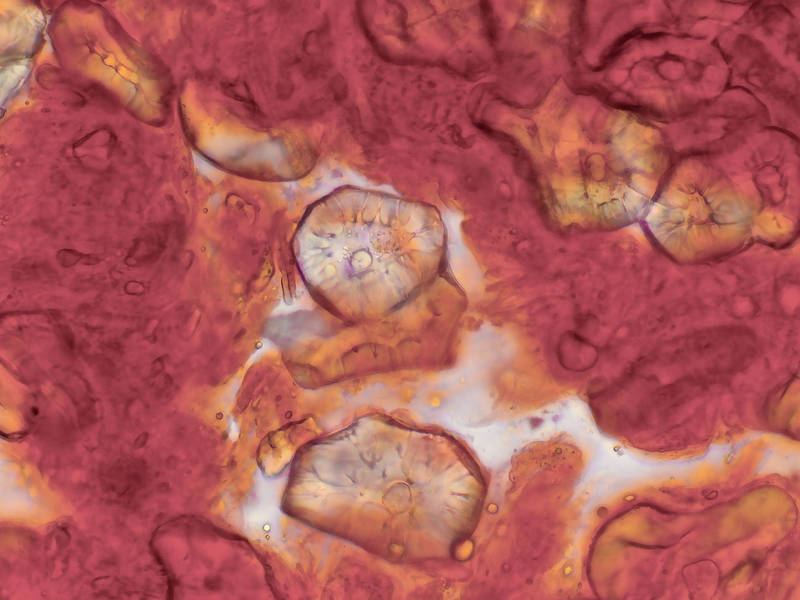
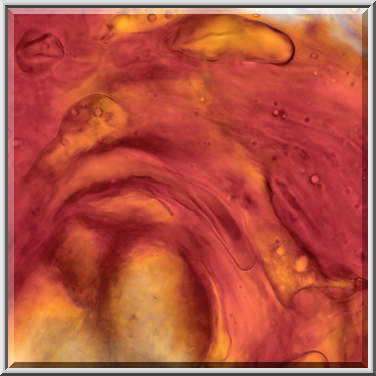
Yellow jelly from seapage slope to creeks under a microscope in lugol, collected on Sand Branch Loop Trail in Sam Houston National Forest near Montgomery. Texas


Album 3341: Sam Houston Forest, Texas, February 12, 2023
The image shows a microscopic view of yellow gelatinous material from a seapage slope to creeks under Lugol's iodine stain. The material is composed of irregularly shaped cells with translucent or transparent centers and brownish-yellow walls. Some cells are partially filled with white, globular structures resembling starch granules.
The background of the image appears to be made up of smaller, more densely packed cells that are not as clearly visible as those in the foreground. The overall appearance suggests that this is a type of algae or plant material that has been stained with Lugol's iodine.
Lugol's iodine stain is commonly used in microscopy to highlight the presence of starch, cellulose, and other polysaccharides in biological samples. It works by reacting with these molecules to produce a characteristic brownish-yellow color.
The fact that the sample was collected from a seapage slope to creeks suggests that it may be related to aquatic or wetland environments. The presence of starch granules within some cells could indicate that this material is derived from plant sources, such as algae or mosses.
Overall, the image provides valuable information about the composition and structure of this yellow gelatinous material, which could have implications for our understanding of its origin and ecological role in the environment where it was found. – AI vision
🇪🇸 Descripción en español / Spanish Description
Material gelatinoso amarillo de pendiente de agua marina a arroyos bajo un microscopio en lugol, recogido en el Sand Branch Loop Trail en la Sam Houston National Forest cerca de Montgomery. Texas, 12 de febrero del 2023. La imagen muestra una vista microscópica del material gelatinoso amarillo de pendiente de agua marina a arroyos bajo tincion con yodo de Lugol. El material está compuesto por células de forma irregular con centros translúcidos o transparentes y paredes parduzcas-amarillentas. Algunas células están parcialmente llenas con estructuras globulares blancas que se asemejan a gránulos de almidón. El fondo de la imagen parece estar compuesto por células más pequeñas y densamente empaquetadas que no son tan visibles como las del primer plano. El aspecto general sugiere que este es un tipo de algas o material vegetal teñido con yodo de Lugol. La tinción con yodo de Lugol se utiliza comúnmente en microscopía para destacar la presencia de almidón, celulosa y otros polisacáridos en muestras biológicas. Funciona haciendo reaccionar estas moléculas para producir un color característico parduzco-amarillento. El hecho de que la muestra se recolectara de una pendiente de agua marina a arroyos sugiere que puede estar relacionado con entornos acuáticos o húmedos. La presencia de gránulos de almidón dentro de algunas células podría indicar que este material se deriva de fuentes vegetales, como algas o musgos. En general, la imagen proporciona información valiosa sobre la composición y estructura de este material gelatinoso amarillo, lo que podría tener implicaciones para nuestra comprensión de su origen y papel ecológico en el entorno donde se encontró. – Spanish translation