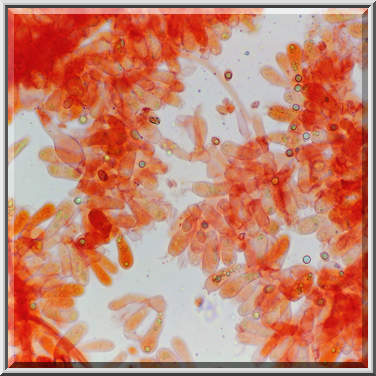
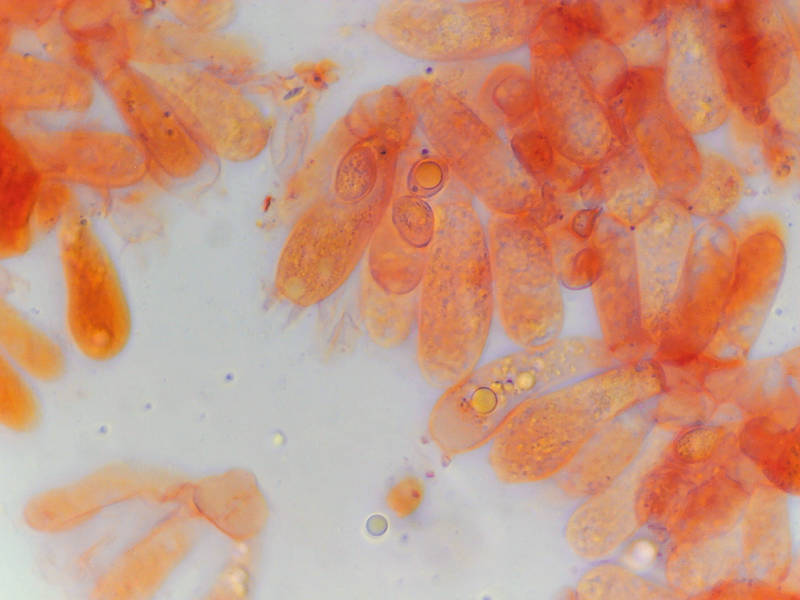
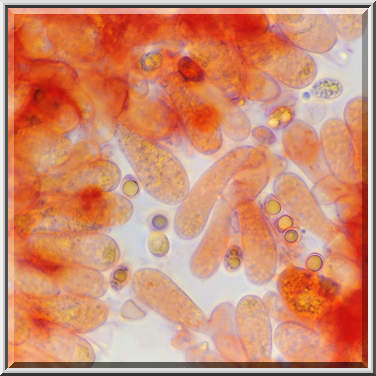
Basidia of mushroom Melanoleuca melaleuca(?) collected on Sand Branch Loop Trail in Sam Houston National Forest near Montgomery. Texas


Album 3341: Sam Houston Forest, Texas, February 12, 2023
The image presents a microscopic view of basidia from a mushroom specimen identified as possibly belonging to Melanoleuca melaleuca. The basidia are characterized by their elongated shape and irregular width, with some displaying a rounded or pointed tip.
**Key Features:**
* **Coloration:** The basidia exhibit a reddish-orange hue, likely due to the presence of melanin pigments.
* **Size Variation:** Basidia vary in size, ranging from approximately 10-30 micrometers in length and 5-15 micrometers in width.
* **Irregular Shape:** Some basidia display an irregular shape or curvature, deviating from their typical elongated form.
**Observations:**
* The image suggests the presence of multiple basidia within a single cell or cluster.
* A few smaller structures resembling spores are visible near the bottom center of the image, possibly indicating an early stage in the fruiting process.
**Conclusion:**
Based on these observations, it is plausible that the mushroom specimen belongs to Melanoleuca melaleuca. However, a definitive identification would require further examination and analysis of additional characteristics or features not visible in this microscopic view. – AI vision
🇪🇸 Descripción en español / Spanish Description
Basidios de hongos Melanoleuca melaleuca (?) recolectados en Sand Branch Loop Trail en la Sam Houston National Forest cerca de Montgomery, Texas, el 12 de febrero del 2023. La imagen presenta una vista microscópica de basidios de un hongo especimen identificado como posiblemente perteneciente a Melanoleuca melaleuca. Los basidios se caracterizan por su forma alargada y ancho irregular, con algunos que presentan una punta redondeada o puntiaguda. **Características clave:** * **Coloración:** Los basidios muestran un tinte rojizo-naranja, probablemente debido a la presencia de pigmentos de melanina. * **Tamaño Variación:** Basidios varían en tamaño, que oscila entre aproximadamente 10-30 micrómetros de longitud y 5-15 micrómetros de anchura. * **Forma irregular:** Algunos basidios muestran una forma irregular o curvatura, desviándose de su forma alargada típica. **Observaciones:** * La imagen sugiere la presencia de múltiples basidios dentro de una sola célula o agrupamiento. * Algunas estructuras más pequeñas similares a esporas son visibles cerca del centro inferior de la imagen, lo que puede indicar una etapa temprana en el proceso de fructificación. **Conclusión:** En base a estas observaciones, es plausible que el espécimen de hongo pertenezca a Melanoleuca melaleuca. Sin embargo, una identificación definitiva requeriría un examen adicional y análisis de características o rasgos no visibles en esta vista microscópica. – Spanish translation


