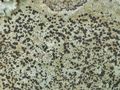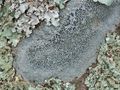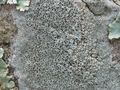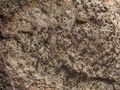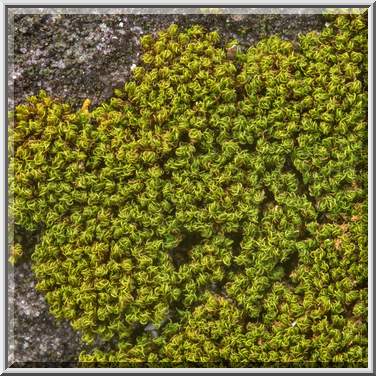
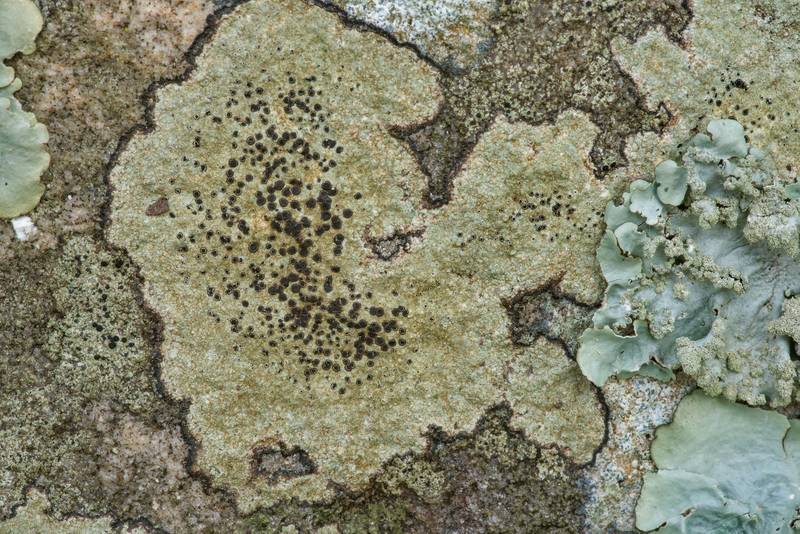
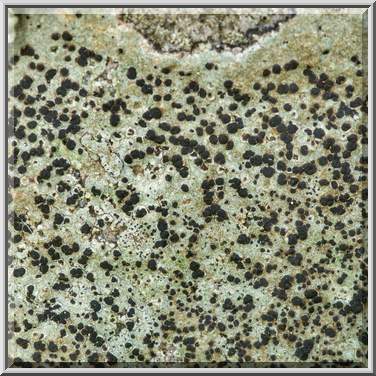
Sunken button lichen (Buellia spuria) and some folios lichen on sandstone at Lake Somerville Trailway near Nails Creek Unit of Somerville Lake State Park. Texas


Album 3350: Lake Somerville, Texas, February 26, 2023
The image presents a close-up view of various lichens growing on a sandstone surface. The lichens are characterized by their distinct shapes and colors, with some appearing greenish-gray and others exhibiting lighter shades.
At the center-right of the image, an area of dark brown or black is visible, which appears to be a sunken button lichen (Buellia spuria). This type of lichen typically grows on rocks and trees in North America, Europe, Asia, Australia, New Zealand, and South Africa. The dark spots may indicate where the organism has broken down organic matter.
Some foliose lichens with rounded lobes or leaves are also visible on the surface. These lichens have flat growths that resemble leaves or scales on their upper surfaces. They often grow in clusters or tufts, and some can be quite large.
The sandstone surface is rough and uneven, providing a suitable environment for these organisms to thrive. The overall appearance of the image suggests that it was taken during the winter season, as indicated by the caption's mention of February 26, 2023. – AI vision
🇪🇸 Descripción en español / Spanish Description
El líquen de botón hundido (Buellia spuria) y algunos folios líquenes en arenisca en el Lake Somerville Trailway cerca de Nails Creek Unit del Parque Estatal de Somerville Lake. Texas, 26 de febrero de 2023. La imagen presenta una vista detallada de varios líquenes que crecen sobre una superficie de arenisca. Los líquenes se caracterizan por sus formas y colores distintivos, con algunos que aparecen grisáceos y otros que muestran tonalidades más claras. En el centro derecho de la imagen, es visible un área marrón oscuro o negro, que parece ser un líquen de botón hundido (Buellia spuria). Este tipo de líquenes crecen típicamente en rocas y árboles en América del Norte, Europa, Asia, Australia, Nueva Zelanda y Sudáfrica. Las manchas oscuras pueden indicar dónde el organismo ha descompuesto la materia orgánica. También son visibles algunos líquenes foliosos con lóbulos o hojas redondeadas sobre la superficie. Estos líquenes tienen crecimientos planos que se asemejan a hojas u óxido en sus superficies superiores. A menudo, crecen agrupados o en mechones y algunos pueden ser bastante grandes. La superficie de arenisca es áspera e irregular, proporcionando un entorno adecuado para que estos organismos prosperen. El aspecto general de la imagen sugiere que fue tomada durante la temporada de invierno, como indica la mención en el pie de foto del 26 de febrero de 2023. – Spanish translation