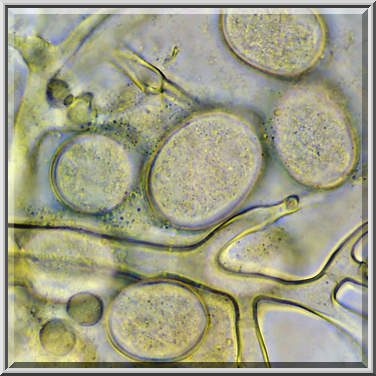
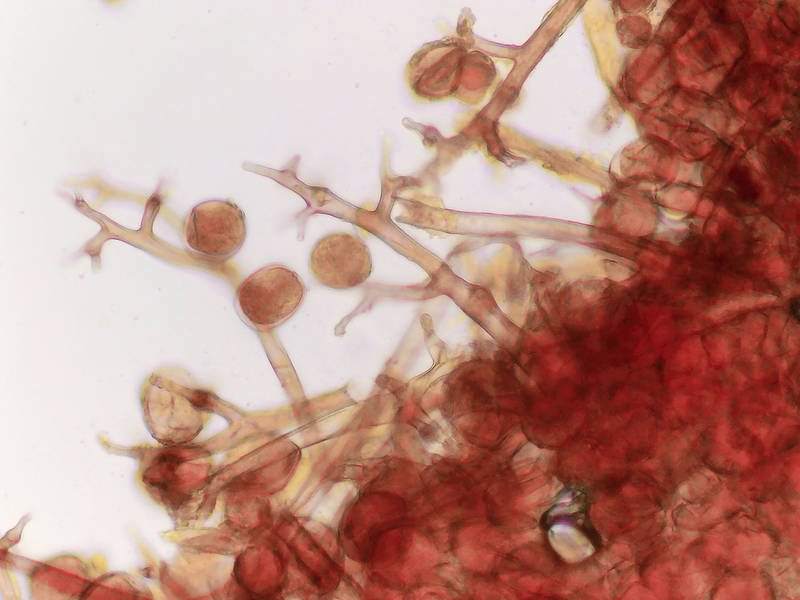
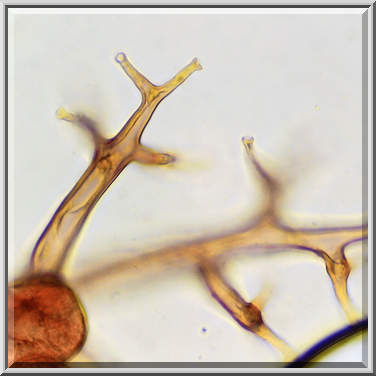
Conidiophores and conidia (in lugol, x40 objective) of downy mildew fungus Plasmopara geranii or may be P. pusilla from a leaf of crane's bill (Geranium carolinianum), collected near Birch Creek Unit of Somerville Lake State Park. Texas


Album 3355: Flowers near Lake Somerville, Texas, March 5, 2023
The image depicts a microscopic view of fungal structures, specifically conidiophores and conidia, from a leaf sample of crane's bill (Geranium carolinianum). The specimen was collected near Birch Creek Unit of Somerville Lake State Park, Texas.
**Key Features:**
* **Conidiophores:** Long, branching hyphae with rounded tips.
* **Conidia:** Small, spherical spores attached to the ends of conidiophores.
* **Lugol Stain:** The sample was stained using Lugol's iodine solution, which causes the fungal structures to stain brown or black.
**Conclusion:**
The image provides a detailed view of the fungal structures from the leaf sample. The presence of conidiophores and conidia is characteristic of downy mildew fungi, such as Plasmopara geranii or P. pusilla, which infect plant leaves and cause disease symptoms. The microscopic examination using Lugol's iodine stain helps to identify the fungal species and confirm its presence in the sample.
**Answer:**
The image depicts a microscopic view of conidiophores and conidia from a leaf sample of crane's bill (Geranium carolinianum), likely infected by downy mildew fungus Plasmopara geranii or P. pusilla, collected near Birch Creek Unit of Somerville Lake State Park, Texas. – AI vision
🇪🇸 Descripción en español / Spanish Description
La imagen muestra una vista microscópica de las estructuras fúngicas, específicamente los conidióforos y conidios, de una muestra de hoja del billar de cabra (Geranium carolinianum). El espécimen fue recolectado cerca de la unidad Birch Creek del Parque Estatal Somerville Lake en Texas. **Características clave:** * **Conidióforos:** Hifas ramificadas largas con puntas redondas. * **Conidios:** Espermatófitos esféricos pequeños unidos a los extremos de los conidióforos. * **Tinción de Lugol:** La muestra fue teñida usando solución de yodo Lugol, lo que hace que las estructuras fúngicas se tiñan de marrón u oscuro. **Conclusión:** La imagen proporciona una vista detallada de las estructuras fúngicas de la muestra. La presencia de conidióforos y conidios es característica del mildiu polvoriento, como Plasmopara geranii o P. pusilla, que infectan las hojas de las plantas y causan síntomas de enfermedades. El examen microscópico usando la tinción de Lugol ayuda a identificar la especie fúngica y confirmar su presencia en la muestra. **Respuesta:** La imagen representa una vista microscópica de los conidiophoros y los conidios, obtenidos de una muestra de hoja del billar de cabra (Geranium carolinianum), probablemente infectados por mildiu polvoriento Plasmopara geranii o P. pusilla, recolectada cerca de la unidad Birch Creek del Parque Estatal Somerville Lake en Texas. – Spanish translation


