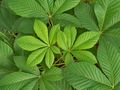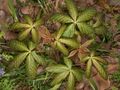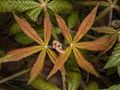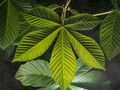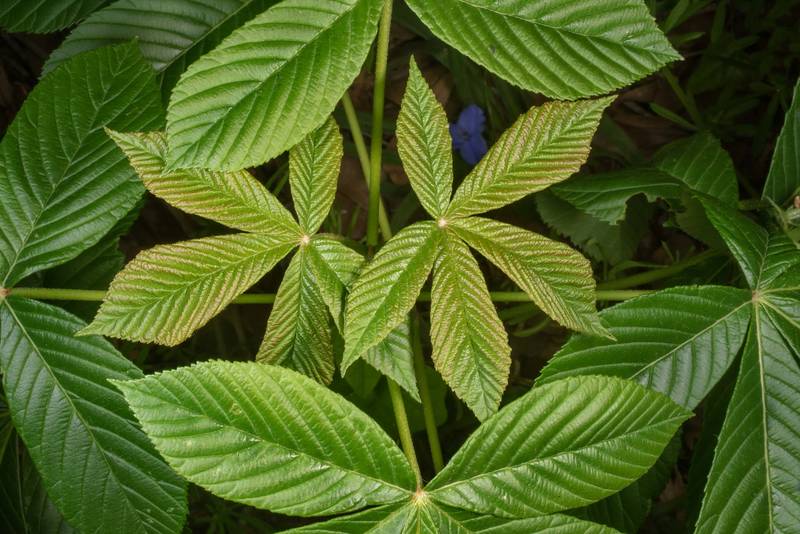

Young leaves of red buckeye (Aesculus pavia) in Washington-on-the-Brazos State Historic Site. Washington, Texas


Album 3357: Washington-on-the-Brazos - Independence, Texas, March 6, 2023
The photograph showcases young, vibrant green leaves from a Red Buckeye tree (Aesculus pavia) within the Washington-on-the-Brazos State Historic Site in Washington, Texas. The leaves are arranged in groups of four or five with a central leaf and three to four smaller leaves radiating outwards along their stems.
The leaves have five lobes, giving them an almost palmate appearance. Each lobe is narrow and pointed at the tip, tapering down slightly towards its base. A distinctive feature of these leaves is their pale yellow or reddish midrib, which adds a touch of elegance to their overall appearance.
In terms of size, the leaves are relatively large, measuring approximately 4-6 inches in length and 2-3 inches in width. This makes them easy to spot amidst other foliage.
The photograph was taken on March 6, 2023, suggesting that it captures a moment during spring or early summer when new growth is evident. The lush green color of the leaves indicates healthy development, with no signs of damage or disease visible.
Overall, this image presents an intimate view of Red Buckeye's young leaves in their natural habitat, showcasing their unique characteristics and beauty. – AI vision
🇪🇸 Descripción en español / Spanish Description
Las hojas jóvenes de roble rojo (Aesculus pavia) en el Washington-on-the-Brazos State Historic Site. Washington, Texas, 6 de marzo de 2023. La fotografía muestra las hojas jóvenes y vibrantes de un árbol de roble rojo (Aesculus pavia) dentro del Washington-on-the-Brazos State Historic Site en Washington, Texas. Las hojas están dispuestas en grupos de cuatro o cinco con una hoja central y tres a cuatro hojas más pequeñas que se irradian hacia afuera a lo largo de sus tallos. Las hojas tienen cinco lóbulos, lo que les da un aspecto casi palmatoso. Cada lóbulo es estrecho y puntiagudo en la punta, estrechándose ligeramente hacia su base. Una característica distintiva de estas hojas es su costilla central amarillo pálido o rojiza, que añade un toque elegante a su aspecto general. En términos de tamaño, las hojas son relativamente grandes, midiendo aproximadamente 4-6 pulgadas de longitud y 2-3 pulgadas de ancho. Esto hace que sean fáciles de detectar entre otros follajes. La fotografía se tomó el 6 de marzo de 2023, lo que sugiere que captura un momento durante la primavera o principios del verano cuando es evidente nuevo crecimiento. El color verde oscuro de las hojas indica un desarrollo sano, sin signos de daño o enfermedad visible. En general, esta imagen presenta una vista íntima de las hojas jóvenes del roble rojo en su hábitat natural, mostrando sus características únicas y belleza. – Spanish translation