
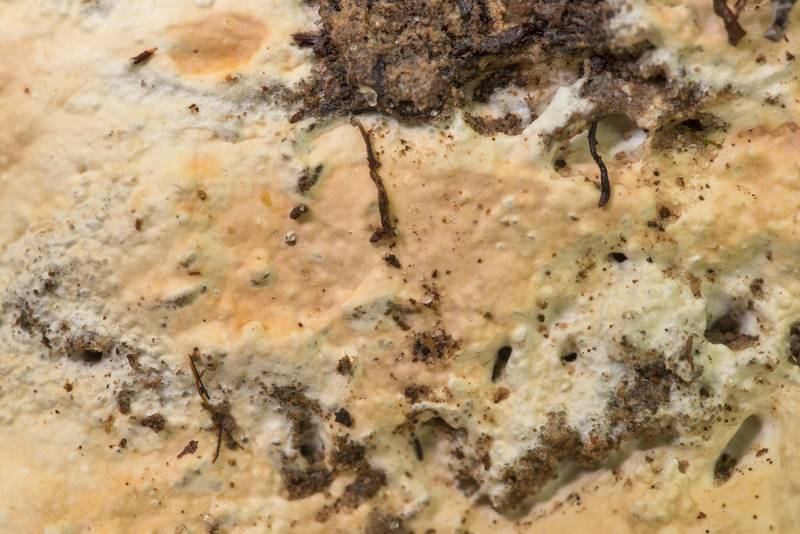
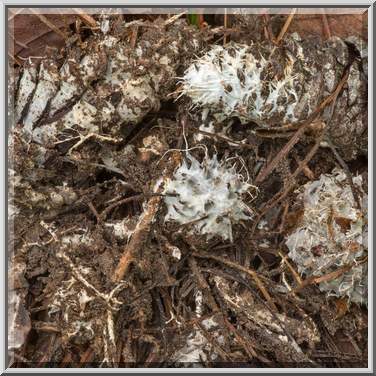
Texture of yellow corticioid fungus from a fallen elm tree, on soil mixed with bark and sand, on Caney Creek Trail (Little Lake Creek Loop Trail) in Sam Houston National Forest north from Montgomery. Texas


Album 3378: Sam Houston Forest, Texas, April 8 - 9, 2023
The image depicts the texture of a yellow corticioid fungus growing on soil mixed with bark and sand. The overall appearance suggests that it is likely to be a type of bracket fungus or conk, which are common in forests and woodlands.
**Coloration:**
The dominant color of the fungus is a pale yellow hue, although there may be some darker brown or black areas present, particularly around the edges or on top of the growth. This could indicate the presence of spores, mycelium, or other components that contribute to its structure and function.
**Texture:**
* The surface of the fungus exhibits a rough, irregular texture.
* There are several small cracks and crevices visible across the surface, which may be indicative of age, weathering, or mechanical damage.
* Some areas appear more dense or compacted than others, possibly due to differences in moisture levels or exposure to environmental factors.
**Shape:**
The shape of the fungus is not immediately apparent from this image alone. However, based on its appearance and location (growing on soil mixed with bark and sand), it is likely that it has a rounded or oval shape, characteristic of many bracket fungi.
**Size:**
It is difficult to determine the exact size of the fungus without additional context or reference points. However, given its texture and coloration, it appears to be relatively small, possibly ranging from a few centimeters to several decimeters in diameter.
**Growth Environment:**
The fact that the fungus is growing on soil mixed with bark and sand suggests that it has adapted to a specific environment characterized by high levels of moisture, humidity, and organic matter. This type of substrate is commonly found in forests and woodlands, particularly near the base of trees or in areas with significant leaf litter accumulation.
**Possible Identification:**
Based solely on visual inspection, it is challenging to identify this fungus definitively without further information about its morphology, habitat, or ecological characteristics. However, some possibilities include species from the genus Xylaria , which are known for their bright yellow colors and ability to grow on decaying wood in forest ecosystems.
**Conclusion:**
In conclusion, the image depicts a pale yellow corticioid fungus growing on soil mixed with bark and sand, likely belonging to a bracket fungus or conk. Its texture suggests age and exposure to environmental factors, while its coloration may indicate the presence of spores or mycelium. Further study would be required to determine its exact identity and ecological significance within its environment. – AI vision
🇪🇸 Descripción en español / Spanish Description
Textura del hongo corticero amarillo de un olmo caído en el suelo mezclado con corteza y arena, en el Caney Creek Trail (Little Lake Creek Loop Trail) en el Bosque Nacional Sam Houston al norte de Montgomery. Texas, 9 de abril del 2023. La imagen muestra la textura de un hongo corticero amarillo que crece en suelo mezclado con corteza y arena. El aspecto general sugiere que es probable que sea un tipo de hongo con setas o tocones, comunes en bosques y matorrales. **Coloración:** El color dominante del hongo es un tono amarillo pálido, aunque pueden estar presentes áreas marrones u oscuras, especialmente alrededor de los bordes o sobre el crecimiento. Esto podría indicar la presencia de esporas, micelio u otros componentes que contribuyen a su estructura y función. **Textura:** * La superficie del hongo presenta una textura áspera e irregular. * Hay varias grietas y hendiduras visibles en toda la superficie, lo que puede ser indicativo de la edad, el desgaste o el daño mecánico. * Algunas áreas parecen más densas o compactadas que otras, posiblemente debido a diferencias en los niveles de humedad o exposición a factores ambientales. **Forma:** La forma del hongo no es inmediatamente evidente a partir de esta imagen sola. Sin embargo, basándose en su aspecto y ubicación (creciendo en suelo mezclado con corteza y arena), es probable que tenga una forma redondeada u ovalada, característica de muchos hongos con setas. **Tamaño:** Es difícil determinar el tamaño exacto del hongo sin contexto adicional o puntos de referencia. Sin embargo, dada su textura y coloración, parece ser relativamente pequeño, posiblemente variando desde unos pocos centímetros hasta varios decímetros de diámetro. **Entorno de crecimiento:** El hecho de que el hongo esté creciendo en suelo mezclado con corteza y arena sugiere que se ha adaptado a un entorno específico caracterizado por altos niveles de humedad, humedad y materia orgánica. Este tipo de sustrato es común en bosques y matorrales, particularmente cerca de la base de árboles o en áreas con acumulación significativa de hojarasca. **Posible identificación:** Basándose únicamente en la inspección visual, es difícil identificar definitivamente este hongo sin más información sobre su morfología, hábitat o características ecológicas. Sin embargo, algunas posibilidades incluyen especies del género Xylaria , conocidas por sus colores amarillos brillantes y capacidad de crecer en madera en descomposición en ecosistemas forestales. **Conclusión:** En conclusión, la imagen muestra un hongo corticero amarillo creciendo en suelo mezclado con corteza y arena, probablemente perteneciente a un hongo con setas o tocones. Su textura sugiere edad y exposición a factores ambientales, mientras que su coloración puede indicar la presencia de esporas o micelio. Se necesita un estudio adicional para determinar su identidad exacta y su importancia ecológica en su entorno. – Spanish translation


