
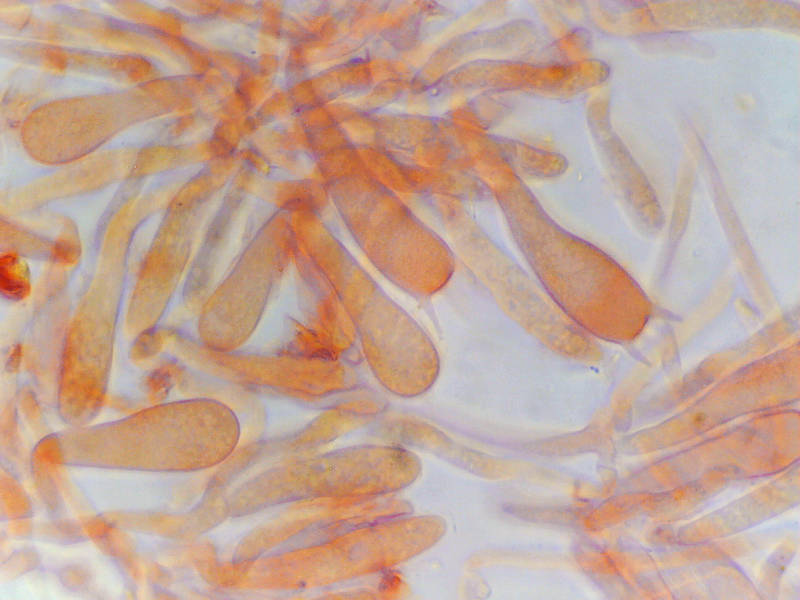

Basidia (in Congo red dye, x100 objective) of small brown Hebeloma(?) mushrooms from burned ground, collected on Stubblefield section of Lone Star hiking trail in Sam Houston National Forest. Texas


Album 3381: Mushrooms in Sam Houston Forest, Texas, April 11, 2023
The image presents a microscopic view of basidia from small brown Hebeloma(?) mushrooms, stained with Congo red dye using a x100 objective lens. The basidia are characterized by their elongated shape and rounded ends, with some appearing slightly curved or twisted.
**Key Features:**
* **Basidial Structure:** The basidia are typically club-shaped, with four sterigmata attached to the apex of each basidium.
* **Congo Red Staining:** The use of Congo red dye highlights the presence of melanin pigments within the basidia, which is a common feature in many species of fungi.
* **Melanization:** Melanization refers to the process by which fungal cells produce melanin, a pigment that helps protect them from environmental stressors such as UV radiation and pathogens.
**Conclusion:**
The image provides valuable information about the morphology and pigmentation of basidia in small brown Hebeloma(?) mushrooms. The use of Congo red dye allows for the visualization of melanin pigments, which can be an important characteristic for identifying and distinguishing between different fungal species. – AI vision
🇪🇸 Descripción en español / Spanish Description
Los basidios (tintados con colorante rojo Congo, objetivo x100) de pequeños hongos marrones Hebeloma(?) que crecen en suelo quemado, recogidos en la sección Stubblefield del sendero Lone Star en el bosque nacional Sam Houston. Texas, 11 de abril de 2023. La imagen muestra una vista microscópica de los basidios de pequeños hongos marrones Hebeloma(?), teñidos con colorante rojo Congo usando un objetivo x100. Los basidios se caracterizan por su forma alargada y extremos redondeados, algunos aparentemente ligeramente curvados o retorcidos. **Características clave:** * **Estructura Basidial:** Los basidios tienen normalmente forma de club, con cuatro esterigmas unidos a la cúspide de cada basidio. * **Tinción con Colorante Rojo Congo:** El uso del colorante rojo Congo destaca la presencia de pigmentos de melanina dentro de los basidios, que es una característica común en muchas especies de hongos. * **Melanización:** La melanización se refiere al proceso por el cual las células fúngicas producen melanina, un pigmento que ayuda a protegerlas del estrés ambiental como la radiación UV y patógenos. **Conclusión:** La imagen proporciona información valiosa sobre la morfología y la pigmentación de los basidios en pequeños hongos marrones Hebeloma(?). El uso del colorante rojo Congo permite la visualización de los pigmentos de melanina, lo que puede ser una característica importante para identificar y distinguir entre diferentes especies de hongos. – Spanish translation


