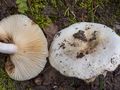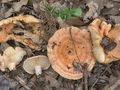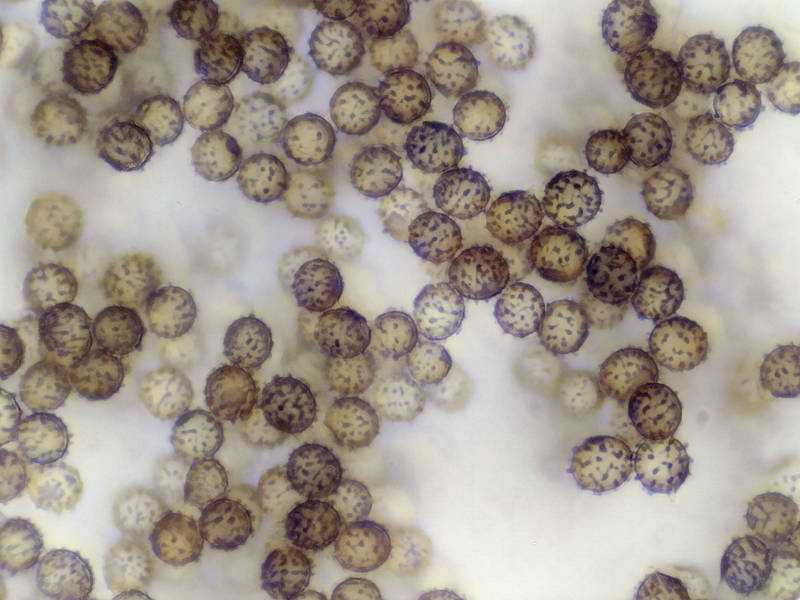

Spores of blackening Russula mushroom (spore print yellowish light brown), collected in Hensel Park. College Station, Texas


Album 3408: College Station, Texas, May 8, 2023
The image presents a microscopic view of spores from a blackening Russula mushroom, showcasing their distinctive characteristics.
* **Spore Shape and Size:** The spores are spherical to subspherical in shape, with diameters ranging between 3.5 to 4 μm. This size range is typical for many species within the genus Russula.
* **Spore Wall Structure:** Upon closer inspection, it becomes apparent that each spore features a smooth wall devoid of ornamentation. The spores are characterized by their homogeneous texture and lack of any noticeable projections or ridges on their surface.
* **Coloration:** A notable feature of these spores is the presence of brownish-yellow pigmentation within the walls, which contributes to the yellowish light brown color observed in the spore print. This pigment may play a role in protecting the spores from environmental stressors and facilitating germination under favorable conditions.
* **Arrangement:** The spores are densely packed and appear to be randomly distributed throughout the image. This arrangement is consistent with the typical morphology of Russula mushroom spores, which often exhibit a uniform distribution within their respective fruiting bodies.
In summary, the microscopic image reveals the characteristic spherical shape, smooth walls, and brownish-yellow pigmentation of the blackening Russula mushroom's spores. These features are diagnostic for identifying this species based on its microscopic characteristics alone. – AI vision
🇪🇸 Descripción en español / Spanish Description
Las esporas del hongo rússula negruzco (impronta de esporas marrón claro amarillento), recogidas en Hensel Park. College Station, Texas, el 8 de mayo de 2023. La imagen presenta una vista microscópica de las esporas del hongo rússula negruzco, mostrando sus características distintivas. * **Forma y tamaño de la espora:** Las esporas son de forma esférica a subesférica, con diámetros que oscilan entre 3,5 y 4 um. Este rango de tamaño es típico para muchas especies del género Rússula. * **Estructura de la pared de la espora:** Tras un examen más detallado, se hace evidente que cada espora presenta una pared lisa desprovista de adornos. Las esporas se caracterizan por su textura homogénea y ausencia de proyecciones o aristas visibles en la superficie. * **Coloración:** Una característica notable de estas esporas es la presencia de pigmentación parduzca dentro de las paredes, lo que contribuye al color marrón claro amarillento observado en la impresión de esporas. Este pigmento puede desempeñar un papel protegiendo a las esporas del estrés ambiental y facilitando su germinación bajo condiciones favorables. * **Disposición:** Las esporas están densamente empaquetadas y parecen estar distribuidas aleatoriamente por toda la imagen. Esta disposición es coherente con la morfología típica de las esporas del hongo rússula, que a menudo presentan una distribución uniforme dentro de sus respectivos cuerpos fructíferos. En resumen, la imagen microscópica revela la forma característicamente esférica, paredes lisas y pigmentación parduzca de las esporas del hongo rússula negruzco. Estas características son diagnósticas para identificar esta especie basándose únicamente en sus características microscópicas. – Spanish translation