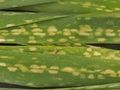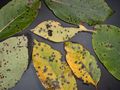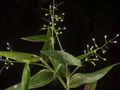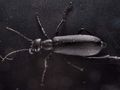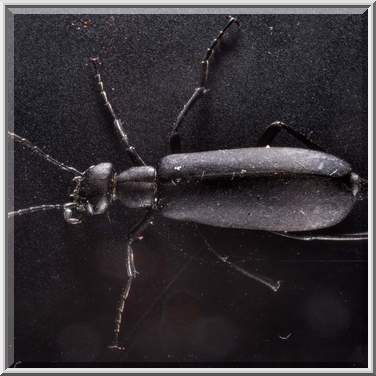
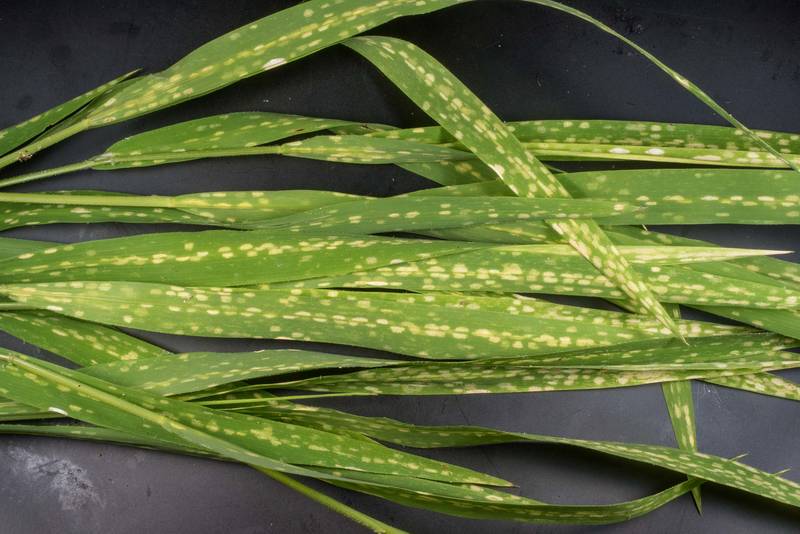
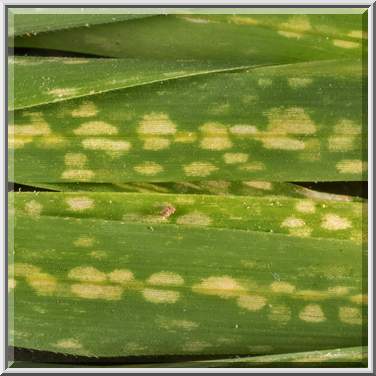
Some grass with yellow spots on leaves from Pole Creek area of Sam Houston National Forest. Texas


Album 3411: College Station, Texas, August 3 - 16, 2023
The image presents a close-up view of a plant's foliage, characterized by long, thin green blades featuring scattered white and yellow spots. The leaves are arranged haphazardly on a dark surface, likely a table or countertop.
This presentation suggests that the photograph was taken for scientific purposes, such as identifying the species or documenting an infestation.
Without additional context, it is challenging to determine the specific type of grass depicted in the image. However, based solely on the visual characteristics described above, one could make some educated guesses:
* The presence of yellow and white spots on the leaves suggests that the plant may be experiencing a disease or pest issue.
* The long, thin blades are consistent with many species of grasses.
* The arrangement of the leaves on the surface implies that the photograph was taken in a controlled environment, such as a laboratory or greenhouse.
In conclusion, while it is difficult to identify the exact type of grass without more information, the image provides valuable insights into the plant's physical characteristics and potential health issues. Further analysis would be necessary to determine the specific species and any underlying causes for the observed symptoms. – AI vision
🇪🇸 Descripción en español / Spanish Description
Alguna hierba con manchas amarillas en las hojas del área de Pole Creek de la Selva Nacional Sam Houston. Texas, 6 de agosto de 2023. La imagen presenta una vista detallada del follaje de una planta, caracterizado por hojas verdes largas y delgadas con manchas blancas y amarillas dispersas. Las hojas están dispuestas aleatoriamente en una superficie oscura, probablemente una mesa o un mostrador. Esta presentación sugiere que la fotografía fue tomada con fines científicos, como identificar la especie o documentar una infestación. Sin contexto adicional, es difícil determinar el tipo específico de hierba representado en la imagen. Sin embargo, solo basándose en las características visuales descritas anteriormente, se podrían hacer algunas suposiciones educadas:
* La presencia de manchas amarillas y blancas en las hojas sugiere que la planta puede estar experimentando un problema de enfermedad o plagas. * Las hojas largas y delgadas son consistentes con muchas especies de hierbas. * La disposición de las hojas en la superficie implica que la fotografía fue tomada en un entorno controlado, como un laboratorio o invernadero. En conclusión, aunque es difícil identificar el tipo exacto de hierba sin más información, la imagen proporciona valiosos conocimientos sobre las características físicas y posibles problemas de salud de la planta. Se necesitaría un análisis adicional para determinar la especie concreta y cualquier causa subyacente de los síntomas observados. – Spanish translation