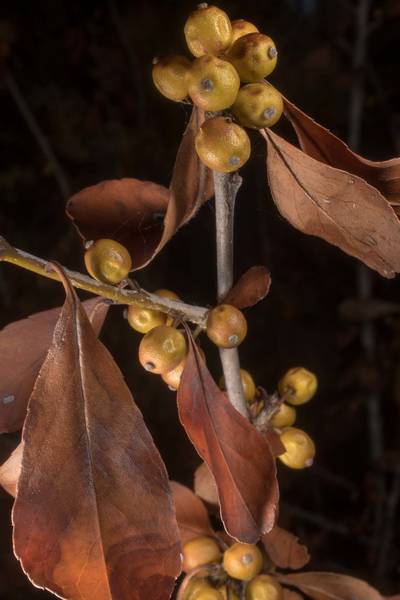

Dry berries of possum-haw holly (Ilex decidua) in David E. Schob Nature Preserve at 906 Ashburn St. College Station, Texas


Album 3412: College Station, Somerville Lake, Sam Houston Forest Texas, August 22 - September 5, 2023
The image depicts a branch of Possum-Haw Holly (Ilex decidua), showcasing its distinctive characteristics. The holly's leaves are typically dark green and glossy during the growing season, but they have turned brown and are beginning to fall off as autumn approaches.
At the end of the branch, clusters of small yellow berries can be seen, which are edible for both humans and wildlife. However, it is essential to note that some individuals may experience gastrointestinal upset if they consume too many berries at once.
The holly plant has been cultivated in gardens since colonial times and has become naturalized in parts of North America. It thrives in full sun to partial shade and can tolerate a range of soil types. This particular specimen is situated within the David E. Schob Nature Preserve, located at 906 Ashburn Street in College Station, Texas.
The image was captured on September 5th, 2023, providing a glimpse into the plant's appearance during late summer or early fall. Overall, the Possum-Haw Holly is a unique and interesting species that can add beauty and interest to gardens and natural areas alike. – AI vision
🇪🇸 Descripción en español / Spanish Description
Bayas secas del cornejo de las ardillas (Ilex decidua) en la reserva natural David E. Schob en 906 Ashburn Street, College Station, Texas, el 5 de septiembre del 2023. La imagen muestra una rama del cornejo de las ardillas (Ilex decidua), que destaca sus características distintivas. Las hojas del cornejo son verde oscuro y lustrosas durante la estación de crecimiento, pero se vuelven marrones y comienzan a caerse a medida que se acerca el otoño. En el extremo de la rama, pueden observarse racimos de pequeñas bayas amarillas, que son comestibles tanto para seres humanos como para la vida silvestre. Sin embargo, es importante señalar que algunas personas pueden experimentar molestias gastrointestinales si consumen demasiadas bayas a la vez. La planta del cornejo se ha cultivado en jardines desde la época colonial y se ha naturalizado en partes de América del Norte. Prospera en pleno sol o sombra parcial y puede tolerar una variedad de tipos de suelo. Este ejemplar particular está situado dentro de la reserva natural David E. Schob, ubicada en 906 Ashburn Street en College Station, Texas. La imagen se capturó el 5 de septiembre del 2023, ofreciendo una mirada a la apariencia de la planta durante el otoño tardío o temprano. En general, el cornejo de las ardillas es una especie única e interesante que puede agregar belleza e interés a jardines y áreas naturales. – Spanish translation