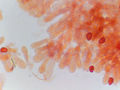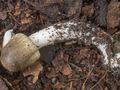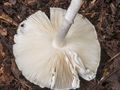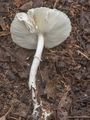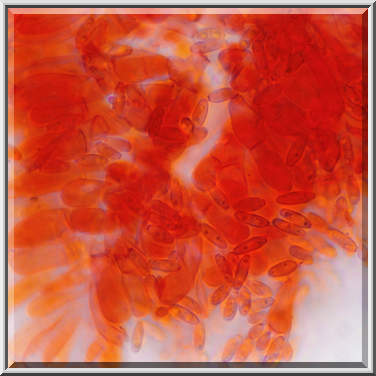
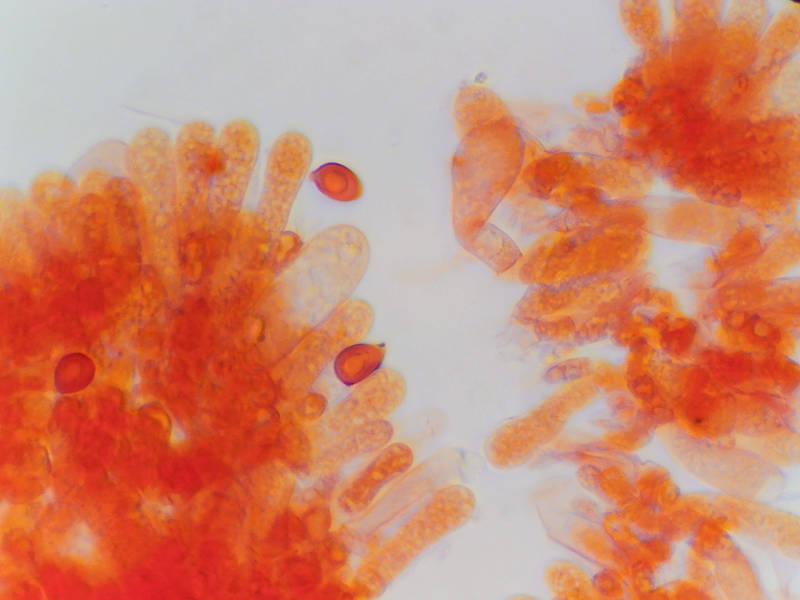
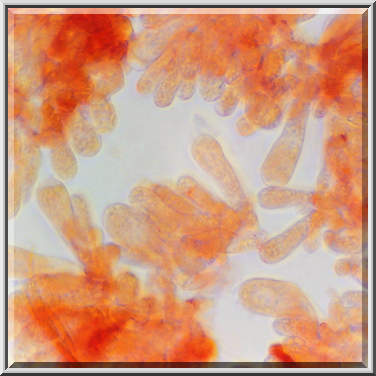
Tissues of Lepiota mushroom with a brown cap collected in Bee Creek Park. College Station, Texas


Album 3421: College Station, Texas, November 6, 2023
The image presents a microscopic view of fungal structures within tissues from a Lepiota mushroom.
The image shows a cluster of elongated, cylindrical fungal hyphae. These hyphae are brown, as indicated by their coloration and the fact that they were collected in Bee Creek Park, Texas, November 6, 2023.
The image is not intended to be scientifically accurate or detailed. It appears to be a low-quality photograph rather than a high-resolution microscopic image. The image does not provide enough information for a definitive identification of the mushroom species. However, based on the description in the caption, it seems likely that the Lepiota mushroom is a species known as Lepiota brunneolocularis, which contains brown-colored fruiting bodies.
The image does not show any other features of the mushroom's tissues or structures beyond the fungal hyphae. There are no visible cells, spores, or other microscopic features that could provide additional information about the mushroom's identity or characteristics.
Overall, while the image provides a general idea of what the fungus looks like under low magnification, it lacks sufficient detail and resolution to be useful for scientific identification or analysis. – AI vision
🇪🇸 Descripción en español / Spanish Description
Los tejidos del hongo Lepiota con un sombrero marrón recogido en el Parque Bee Creek. College Station, Texas, noviembre 6, 2023. La imagen presenta una vista microscópica de las estructuras fúngicas dentro de los tejidos de un hongo Lepiota. La imagen muestra una agrupación de hifas cilíndricas alargadas y fúngicas. Estas hifas son marrones, como indica su coloración y el hecho de que se recogieron en el Parque Bee Creek, Texas, noviembre 6, 2023. La imagen no pretende ser científicamente precisa o detallada. Parece ser una fotografía de baja calidad en lugar de una imagen microscópica de alta resolución. La imagen no proporciona suficiente información para una identificación definitiva de la especie de hongo. Sin embargo, basándose en la descripción del subtítulo, parece probable que el hongo Lepiota sea una especie conocida como Lepiota brunneolocularis, que contiene cuerpos fructíferos marrones. La imagen no muestra ninguna otra característica de los tejidos o estructuras del hongo más allá de las hifas fúngicas. No hay células visibles, esporas u otras características microscópicas que podrían proporcionar información adicional sobre la identidad o características del hongo. En general, aunque la imagen proporciona una idea general de cómo se ve el hongo a baja ampliación, carece de detalles y resolución suficientes para ser útil para la identificación o análisis científico. – Spanish translation