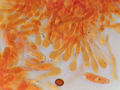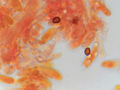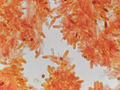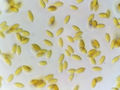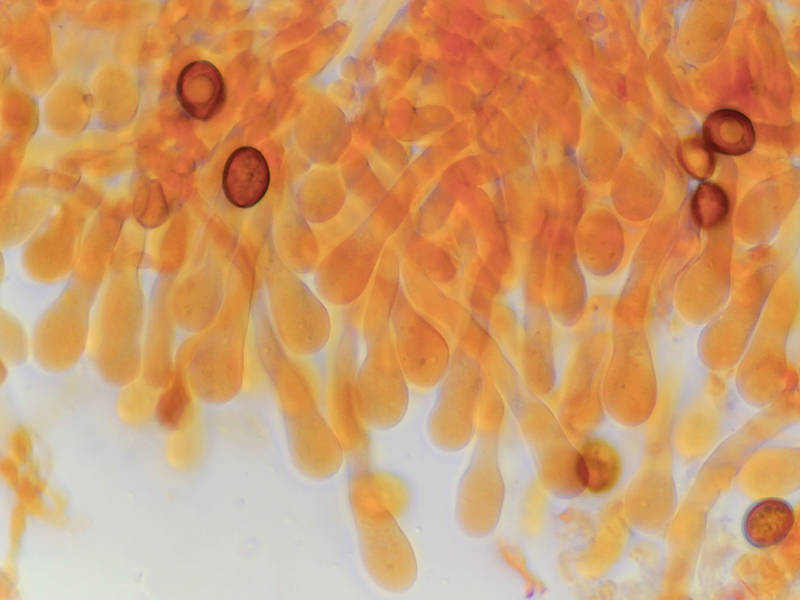
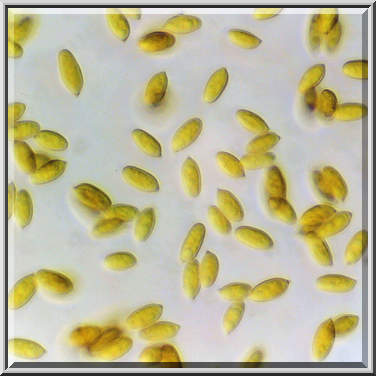
Cystidia and spores of orange oysterling mushrooms from a vertically cut surface of an oak log, collected in Sam Houston National Forest north from Montgomery. Texas


Album 3425: Mushrooms from Sam Houston Forest under a microscope, Texas, November 12 - 13, 2023
The image presents a detailed microscopic view of the spore-bearing structures and cells (cystidia) of orange oysterling mushrooms growing on an oak log. The spores are oval-shaped with thick walls that are reddish-brown to brown in color.
This microscopic image is likely from a laboratory setting where mycologists examine the morphology of fungal species at various magnifications. By examining these structures under high magnification, researchers can identify and classify different types of mushrooms based on their physical characteristics. The orange oysterling mushroom is classified as Pleurotus ostreatus var. citrinopileatus.
This variety is known for its bright orange to yellowish-orange cap color and gills, which are typically white or pale yellow in color. It often grows on decaying wood and can be found throughout the year in various parts of North America. The microscopic image provides a detailed view of the spore-bearing structures and cells that help identify this species.
In summary, the image is a microscopic view of the spore-bearing structures and cells of orange oysterling mushrooms growing on an oak log. The identification of these structures allows researchers to classify and study various types of mushrooms based on their physical characteristics. – AI vision
🇪🇸 Descripción en español / Spanish Description
Las quitinas y las esporas de las setas Oysterling naranjas de una superficie cortada verticalmente de un tronco de roble, recolectadas en el Bosque Nacional Sam Houston al norte de Montgomery, Texas, el 12 de noviembre de 2023. La imagen presenta una vista microscópica detallada de las estructuras portadoras de esporas y las células (quitinas) de las setas Oysterling naranjas que crecen en un tronco de roble. Las esporas son de forma ovalada con paredes gruesas que son de color pardo rojizo a marrón. Esta imagen microscópica probablemente provenga de un entorno de laboratorio donde los micólogos examinan la morfología de las especies de hongos con diversas ampliaciones. Al examinar estas estructuras bajo gran aumento, los investigadores pueden identificar y clasificar diferentes tipos de setas en función de sus características físicas. La seta Oysterling naranja se clasifica como Pleurotus ostreatus var. Citrinopileatus. Esta variedad es conocida por su sombrero de color naranja brillante a amarillo-naranja y sus pliegues, que son de color blanco o amarillo pálido. Crece con frecuencia en madera en descomposición y puede encontrarse a lo largo del año en varias partes de América del Norte. La imagen microscópica proporciona una vista detallada de las estructuras portadoras de esporas y las células que ayudan a identificar esta especie. En resumen, la imagen es una vista microscópica de las estructuras portadoras de esporas y las células de las setas Oysterling naranjas que crecen en un tronco de roble. La identificación de estas estructuras permite a los investigadores clasificar y estudiar diversos tipos de setas en función de sus características físicas. – Spanish translation