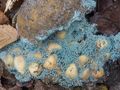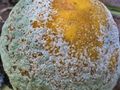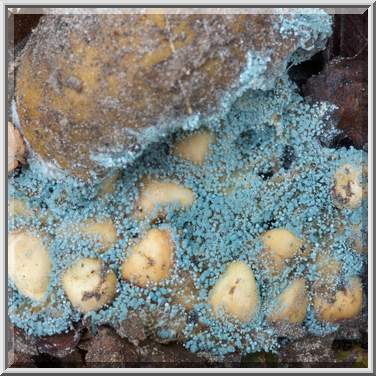
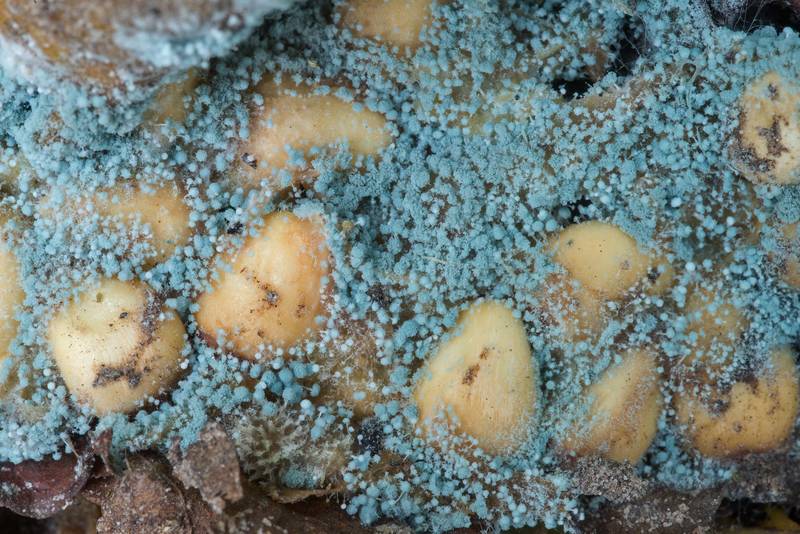
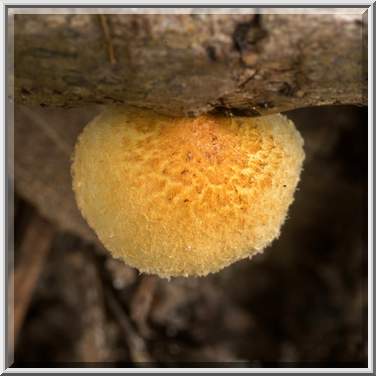
Close-up of blue mould caused by fungus Penicillium italicum on a crashed fruit of trifoliate orange on Caney Creek Trail (Little Lake Creek Loop Trail) in Sam Houston National Forest north from Montgomery. Texas


Album 3427: College Station - Sam Houston Forest, Texas, November 17 - 18, 2023
The image presents a close-up view of blue mold caused by the fungus Penicillium italicum on a crashed fruit of trifoliate orange. The fruit's surface is covered with small, round, light-blue to turquoise-colored spores, which are characteristic of this type of mold.
**Key Features:**
* **Fruit:** The fruit appears to be partially crushed or damaged, possibly due to accidental damage or natural decay.
* **Mold Growth:** The blue mold has grown on the surface of the fruit, covering it with a thick layer of spores. These spores are likely responsible for the fruit's decay and subsequent infection by other microorganisms.
**Context:**
The image was taken in Sam Houston National Forest north from Montgomery, Texas, on November 18, 2023. This suggests that the fruit may have been exposed to environmental factors such as high humidity or temperature fluctuations, contributing to the growth of mold.
**Significance:**
The presence of blue mold caused by Penicillium italicum can indicate poor storage conditions or handling practices. Proper food safety measures and hygiene protocols should be implemented to prevent similar incidents in the future. – AI vision
🇪🇸 Descripción en español / Spanish Description
Un primer plano del moho azul provocado por el hongo Penicillium italicum en un fruto estrellado de naranja trifoliada en el Caney Creek Trail (Little Lake Creek Loop Trail) en la Sam Houston National Forest al norte de Montgomery. Texas, 18 de noviembre de 2023. La imagen presenta una vista detallada del moho azul provocado por el hongo Penicillium italicum en un fruto estrellado de naranja trifoliada. La superficie del fruto está cubierta con pequeñas esporas redondas, de color azul claro a turquesa, que son características de este tipo de moho. **Características Clave:** * **Fruto:** El fruto parece estar parcialmente aplastado o dañado, posiblemente debido a un daño accidental o deterioro natural. * **Crecimiento del moho:** El moho azul ha crecido en la superficie del fruto, cubriéndolo con una capa gruesa de esporas. Estas esporas son probablemente responsables del deterioro del fruto y la posterior infección por otros microorganismos. **Contexto:** La imagen se tomó en la Sam Houston National Forest al norte de Montgomery, Texas, el 18 de noviembre de 2023. Esto sugiere que el fruto puede haber estado expuesto a factores ambientales como una alta humedad o fluctuaciones de temperatura, lo que contribuye al crecimiento del moho. **Significado:** La presencia del moho azul provocado por Penicillium italicum puede indicar malas condiciones de almacenamiento o prácticas de manejo. Se deben implementar medidas adecuadas de seguridad alimentaria e higiene para prevenir incidentes similares en el futuro. – Spanish translation