
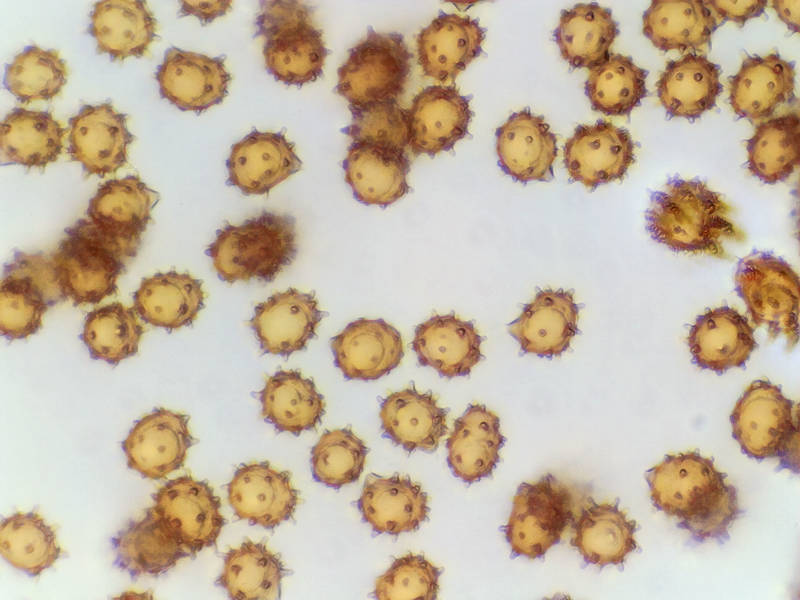

Spores (in lugol) of fibrecap mushrooms Inocybe lanuginosa collected a day before in Sam Houston National Forest. Texas


Album 3431: College Station, Texas, November 20, 2023
The image displays a collection of spores from fibrecap mushrooms (Inocybe lanuginosa) that were captured using the Lugol stain method. The spores are small, spherical, and exhibit an irregularly shaped outline, characterized by numerous short, thin projections or warts covering their surface. These projections appear to be randomly distributed across each spore's surface.
The overall appearance of the spores is reminiscent of a fuzzy or hairy texture, which suggests that they may have been influenced by environmental factors during their development. The image does not provide information about the size of the spores, but it is likely that they are microscopic in nature, given the context of the caption and the typical characteristics of fungal spores.
The presence of many spores on the slide indicates that the sample was collected from a large number of mushrooms, possibly from multiple specimens. The fact that the spores were collected using the Lugol stain method suggests that they were likely identified based on their microscopic appearance under a microscope, rather than through other means such as observation with the naked eye or under magnification.
Overall, the image provides valuable information about the morphology and characteristics of the fibrecap mushrooms' spores, which can be useful for taxonomic identification, ecological studies, and other scientific research purposes. – AI vision
🇪🇸 Descripción en español / Spanish Description
Esporas (en lugol) de hongos Fibrecap Inocybe lanuginosa recolectadas un día antes en el Bosque Nacional Sam Houston. Texas, 20 de noviembre de 2023. La imagen muestra una colección de esporas de hongos Fibrecap (Inocybe lanuginosa) que se capturaron usando el método de tinción Lugol. Las esporas son pequeñas, esféricas y presentan un contorno irregularmente conformado, caracterizado por numerosas proyecciones cortas y delgadas o verrugas que cubren su superficie. Estas proyecciones parecen estar distribuidas aleatoriamente en toda la superficie de cada espora. La apariencia global de las esporas recuerda una textura peluda o vellosa, lo que sugiere que puede haber sido influenciada por factores ambientales durante su desarrollo. La imagen no proporciona información sobre el tamaño de las esporas, pero es probable que sean de naturaleza microscópica, dado el contexto del título y las características típicas de las esporas fúngicas. La presencia de muchas esporas en el portaobjetos indica que la muestra fue recolectada de un gran número de hongos, posiblemente de múltiples especímenes. El hecho de que se hayan recolectado las esporas usando el método de tinción Lugol sugiere que fueron identificadas probablemente en función de su apariencia microscópica bajo un microscopio, en lugar de mediante otros medios como la observación a simple vista o con aumento. En general, la imagen proporciona información valiosa sobre la morfología y las características de las esporas de los hongos Fibrecap, lo que puede ser útil para fines de identificación taxonómica, estudios ecológicos y otros propósitos de investigación científica. – Spanish translation


