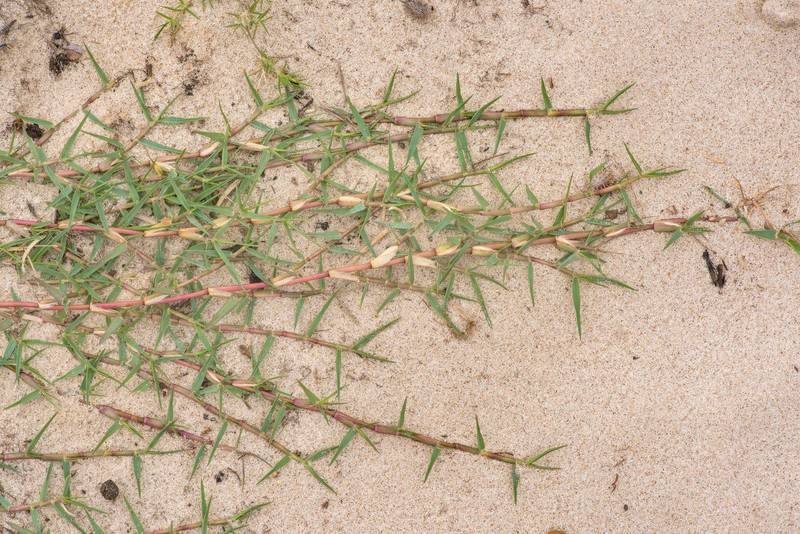
Common creeping grass on sand on a shore of Lake Somerville in Birch Creek Unit of Somerville Lake State Park. Texas


Album 3432: College Station - Lake Somerville, Texas, November 22 - 23, 2023
The image depicts a close-up view of common creeping grass growing in the sand on a shoreline of Lake Somerville in Texas.
**Grass Appearance**
* The grass appears to be a type of annual grass with long blades and stems.
* Each blade has multiple nodes, indicating that it is a stem that can grow up to several feet tall. This suggests that the plant may not be as short as initially thought.
**Coloration and Texture**
* The blades are green in color, which indicates they have sufficient water and nutrients to carry out photosynthesis.
* The stems appear reddish or purplish in hue, possibly due to environmental stressors such as high temperatures, drought, or exposure to strong sunlight. This is a common adaptation for some plants that helps them survive in harsh conditions.
**Growth Pattern**
* The grass appears to be growing horizontally along the sand surface rather than upright towards the sky.
* It may be using its roots to anchor itself firmly into the loose, sandy soil and then spreading outwards through stolons or runners to colonize new areas. This is a common growth pattern for many types of grasses.
**Environmental Context**
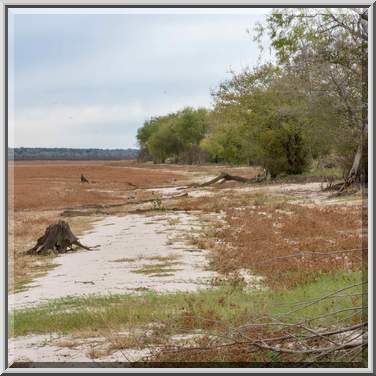
* The image was taken at Lake Somerville in Texas during November 2023.
* The presence of sand on the shoreline suggests that the lake may be part of a larger wetland ecosystem, which supports a diverse range of plant and animal species. – AI vision
🇪🇸 Descripción en español / Spanish Description
El césped común rastrero en la arena de una orilla del lago Somerville en la unidad Birch Creek del Lago Somerville State Park. Texas, noviembre 23, 2023. La imagen muestra una vista detallada del césped común creciendo en la arena de la orilla del lago de Somerville en Texas. **Apariencia del Césped** * El césped parece ser un tipo de hierba anual con hojas y tallos largos. * Cada hoja tiene múltiples nudos, lo que indica que es un tallo que puede crecer hasta varios pies de alto. Esto sugiere que la planta puede no ser tan corta como se pensaba inicialmente. **Coloración y Textura** * Las hojas son de color verde, lo que indica que tienen agua y nutrientes suficientes para llevar a cabo la fotosíntesis. * Los tallos aparecen rojizos o parduscos, posiblemente debido a estresores ambientales como altas temperaturas, sequía o exposición al sol fuerte. Esto es una adaptación común en algunas plantas que las ayuda a sobrevivir en condiciones duras. **Patrón de crecimiento** * El césped parece estar creciendo horizontalmente a lo largo de la superficie de arena en lugar de crecer hacia arriba hacia el cielo. * Puede estar usando sus raíces para anclarse firmemente en el suelo arenoso y luego propagarse hacia afuera a través de estolones o rizomas para colonizar nuevas áreas. Este es un patrón de crecimiento común en muchos tipos de césped. **Contexto ambiental** * La imagen fue tomada en el lago Somerville en Texas durante noviembre 2023. * La presencia de arena en la orilla del lago sugiere que el lago puede ser parte de un ecosistema húmedo más grande, que soporta una diversidad de especies de plantas y animales. – Spanish translation