 |
| |||||||||||||||

| ||||||||||||||||


| Similar |   |
  |
  |
  |
  |
| |||||||||||||||||||||||||||
| |||||||||||||||||||||||||||
| 1996 1997 1998 1999 2000 2001 2002 2003 2004 2005 2006 2007 2008 2009 2010 2011 2012 2013 2014 2015 2016 2017 2018 2019 2020 2021 2022 2023 2024 2025 2026 | |||||||||||||||||||||||||||
| New version Slide Show Most Popular Full List Statistics Technical Details Home Page | |||||||||||||||||||||||||||
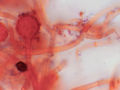
Mucor mold-like fungi, specifically Phycomyces or Zygomyces, were observed in poop samples collected from the Sam Houston National Forest near Montgomery, Texas on December 2, 2023. The hyphae and spores (?) of these fungi were captured with a x100 objective, revealing their intricate details. These findings provide valuable insights into the diversity of fungal species present in this ecosystem. – generated by AI |
The microscopic image displays long, thin hyphae with circular bodies embedded within them. The hyphae appear to be orange and are oriented diagonally from left to right across the image. The background is white with faintly visible concentric circles. Based on the description of this organism as "Mucor mold-like fungus Phycomyces or Zygomyces," it can be inferred that these structures represent hyphae, which are branching filaments in fungi that form a network called mycelium and give rise to fruiting bodies. The circular bodies embedded within the hyphae likely represent spores. The image suggests that this sample was collected from decaying organic matter (poop), possibly due to its being in close proximity to animal feces or plants that are rich in nutrients for fungi growth. Additionally, the fact that it's a mold-like fungus indicates that it thrives in moist environments with abundant organic matter. The presence of spores in this sample suggests that the organism is actively reproducing. The image appears to have been captured using an x100 objective lens on a microscope, which allows for detailed examination of small objects such as microorganisms. – AI vision |
Hifas y esporas(?) (con un objetivo de x100) del hongo similar al moho Phycomyces o Zygomyces del excremento, recolectado en el bosque nacional Sam Houston cerca de Montgomery. Texas, 2 de diciembre de 2023. La imagen microscópica muestra hifas largas y finas con cuerpos circulares incrustados dentro de ellas. Las hifas parecen ser de color naranja y están orientadas en diagonal desde la izquierda a la derecha a través de la imagen. El fondo es blanco con círculos concéntricos débilmente visibles. Basándose en la descripción de este organismo como "hongo similar al moho Phycomyces o Zygomyces", se puede inferir que estas estructuras representan hifas, que son filamentos ramificados en los hongos que forman una red llamada micelio y dan lugar a cuerpos fructíferos. Los cuerpos circulares incrustados dentro de las hifas probablemente representen esporas. La imagen sugiere que esta muestra se recolectó de materia orgánica en descomposición (excremento), posiblemente debido a estar cerca de heces animales o plantas ricas en nutrientes para el crecimiento de hongos. Además, el hecho de que sea un hongo similar a moho indica que florece en entornos húmedos con abundante materia orgánica. La presencia de esporas en esta muestra sugiere que el organismo se reproduce activamente. Parece que la imagen fue capturada utilizando un objetivo de x100 en un microscopio, lo que permite el examen detallado de pequeños objetos como microorganismos. – Spanish translation |
Keyword variants
microscopy
micrograph
Houston National Forest online image
high resolution online digital collection
Lone Star State
United States
picture gallery
photo album
documentary photographs
daily pics
TX
travelogue
snapshots
sightseeing
photowalks
photoblog
graphic
fotografias
foto
America