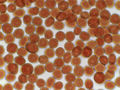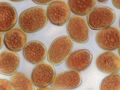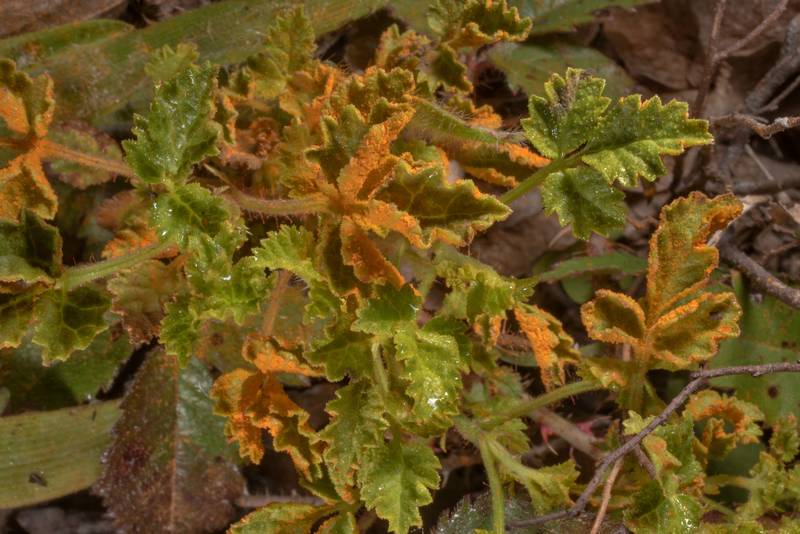

Orange berry rust fungus Gymnoconia nitens on shoots of blackberry on a trailway near Birch Creek Unit of Somerville Lake State Park. Texas


Album 3481: Lake Somerville, Texas, March 2, 2024
The image depicts an outdoor setting with green leaves covered in orange spores or fungus. The plant appears to be some kind of berry bush, based on its structure and leaf shape; however, there is no indication as to what specific type of plant it may be.
The leaves have a serrated edge, are dark green on the top side and light green on the underside, and are growing in clusters from the main stem. The orange spores appear on both the top and bottom sides of the leaves, indicating that they are not just stuck to one side but rather embedded within the leaf tissue.
The plant is likely a host for an infection caused by Gymnoconia nitens, or "orange berry rust fungus." This type of fungus can cause serious damage to plants and trees by reducing their ability to carry out photosynthesis. The spores appear as small orange spots on the leaves, which are usually arranged in clusters around the veins.
The overall appearance of this plant suggests that it is infected with the Gymnoconia nitens fungus. – AI vision
🇪🇸 Descripción en español / Spanish Description
El hongo de la roya del arándano naranja Gymnoconia nitens en brotes de mora en un camino cerca de Birch Creek Unit de Somerville Lake State Park, Texas, el 2 de marzo de 2024. La imagen muestra un entorno al aire libre con hojas verdes cubiertas de esporas naranjas u hongos. La planta parece ser algún tipo de arbusto de bayas, basándose en su estructura y forma de hoja; sin embargo, no hay indicación de qué tipo específico de planta puede ser. Las hojas tienen un borde serrado, son verde oscuro por arriba y verde claro por debajo, y están creciendo en racimos desde el tallo principal. Las esporas naranjas aparecen en ambos lados de las hojas, lo que indica que no solo se quedan pegadas a un lado sino que también están incrustadas dentro del tejido foliar. Es probable que la planta sea un huésped para una infección causada por Gymnoconia nitens o "hongo de la roya del arándano naranja". Este tipo de hongo puede causar daños graves a plantas y árboles al reducir su capacidad para llevar a cabo la fotosíntesis. Las esporas aparecen como pequeñas manchas naranjas en las hojas, que generalmente están dispuestas en racimos alrededor de las venas. El aspecto general de esta planta sugiere que está infectada con el hongo Gymnoconia nitens. – Spanish translation