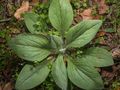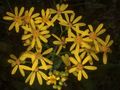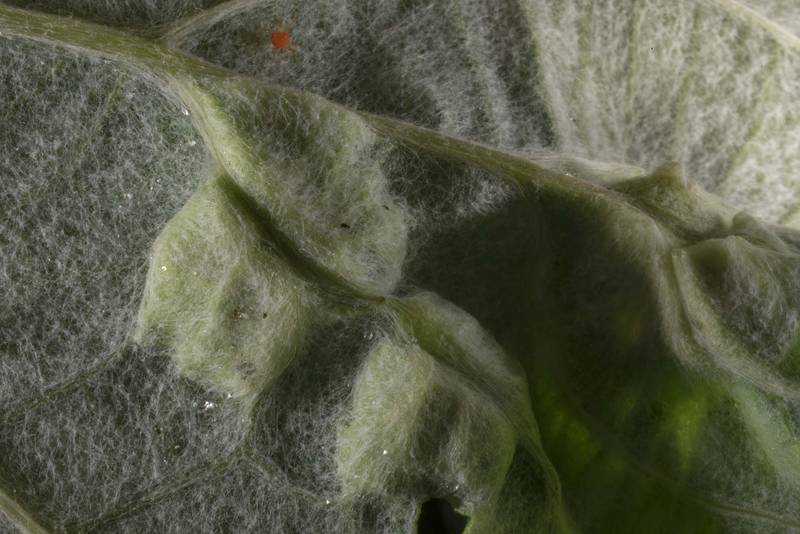

Gall from underside of a leaf of squaw-weed (Senecio ampullaceus) in Bee Creek Park. College Station, Texas


Album 3509: College Station, Texas, April 8 - 12, 2024
The image depicts a close-up view of a plant's leaf, showcasing its underside and featuring a gall growth. The leaf is green with visible veins, indicating that it is likely from a plant species within the family Asteraceae, commonly known as the daisy or sunflower family.
**Key Features:**
* **Gall Growth:** A small, rounded, light-green structure protrudes from the underside of the leaf, possibly an insect gall. The coloration and shape suggest that it may be caused by an insect, such as a fly or wasp larva, feeding on the plant's tissue.
* **Leaf Characteristics:** The leaf appears to be relatively large, with visible veins radiating from its central stem. Its surface is covered in fine hairs or trichomes, which are common in many plant species and serve various functions, including protection against herbivores and water conservation.
* **Background:** The background of the image is not visible due to the close-up nature of the photograph, but it appears to be a dark-colored surface, possibly a table or other flat object.
**Conclusion:**
Overall, the image provides a detailed view of a plant's leaf and its unique features, including the gall growth on the underside. The presence of this growth suggests that the plant may be hosting an insect species, which is not uncommon in nature. – AI vision
🇪🇸 Descripción en español / Spanish Description
El agallamiento de la parte inferior de una hoja de hierba trillada (Senecio ampullaceus) en Bee Creek Park. College Station, Texas, 9 de abril de 2024. La imagen muestra una vista detallada de una hoja de planta, mostrando su parte inferior y presentando un crecimiento del agallamiento. La hoja es verde con venas visibles, lo que indica que probablemente pertenece a una especie de planta dentro de la familia Asteraceae, comúnmente conocida como la familia de las margaritas o girasoles. **Características clave:** * **Crecimiento del agallamiento:** una estructura pequeña, redonda y de color verde claro sobresale de la parte inferior de la hoja, posiblemente un agallamiento producido por insectos. La coloración y forma sugieren que puede estar causado por un insecto, como una larva de mosca o avispa, alimentándose del tejido de la planta. * **Características de las hojas:** la hoja parece ser relativamente grande, con venas visibles que se irradian desde su tallo central. Su superficie está cubierta de pelos finos o tricomas, lo que es común en muchas especies vegetales y sirve para diferentes funciones, como la protección contra los herbívoros y la conservación del agua. * **Fondo:** el fondo de la imagen no es visible debido a la naturaleza detallada de la fotografía, pero parece ser una superficie de color oscuro, posiblemente una mesa u otro objeto plano. **Conclusión:** en general, la imagen proporciona una vista detallada de una hoja de planta y sus características únicas, incluido el crecimiento del agallamiento en la parte inferior. La presencia de este crecimiento sugiere que la planta puede estar albergando una especie de insecto, lo que no es infrecuente en la naturaleza. – Spanish translation