
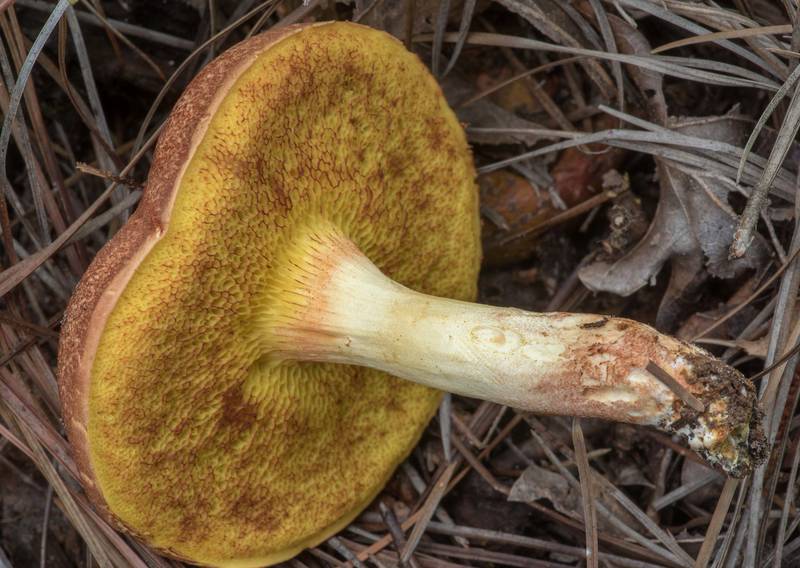

Underside of a mushroom Boletus ochraceoluteus(?) in Bastrop State Park. Bastrop, Texas


Album 3539: Bastrop, Texas, May 17, 2024
The image presents an overhead view of the underside of a mushroom, specifically a member of the genus Boletus, likely identified as B. ochraceoluteus based on its coloration and characteristics. The mushroom is situated on a bed of dry grass or leaves.
**Physical Characteristics:**
* **Cap:** The cap of the mushroom exhibits a vibrant yellow hue with brownish-red striations, characteristic of the species.
* **Stem:** A long, thin stem connects the cap to the base of the mushroom, featuring a white coloration with brownish-red patches at its tip.
* **Pore Surface:** The underside of the mushroom boasts numerous small pores arranged in a radial pattern around the stem.
**Background:**
* **Grass or Leaves:** The mushroom rests on a layer of dry grass or leaves, providing a natural setting for the specimen.
**Overall Observation:**
The image provides a detailed view of the mushroom's underside, highlighting its distinctive coloration and structural features. The presence of the mushroom in a natural environment, surrounded by dried vegetation, suggests that it was discovered growing in its natural habitat. – AI vision
🇪🇸 Descripción en español / Spanish Description
El lado inferior de un hongo Boletus ochraceoluteus(?) en el Bastrop State Park. Bastrop, Texas, May 17, 2024. La imagen presenta una vista aérea del lado inferior de un hongo, específicamente un miembro del género Boletus, probablemente identificado como B. ochraceoluteus en base a su coloración y características. El hongo está situado sobre un lecho de hierba o hojas secas. **Características Físicas:** * **Sombrero:** El sombrero del hongo presenta un tono amarillo vibrante con rayas marronrojizas, característico de la especie. * **Tallo:** Un tallo largo y delgado conecta el sombrero a la base del hongo, con una coloración blanca con parches marronrojizos en su punta. * **Superficie de los Poros:** La parte inferior del hongo cuenta con numerosos poros pequeños dispuestos en un patrón radial alrededor del tallo. **Antecedentes:** * **Hierba o Hojas:** El hongo descansa sobre una capa de hierba seca u hojas, proporcionando un entorno natural para el espécimen. **Observación General:** La imagen provee una vista detallada del lado inferior del hongo, resaltando su coloración distintiva y características estructurales. La presencia del hongo en un ambiente natural, rodeado de vegetación seca, sugiere que fue descubierto creciendo en su hábitat natural. – Spanish translation


