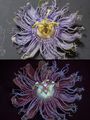
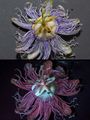
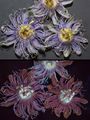
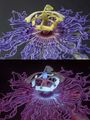
The above photograph shows a passion flower (Passiflora foetida), with the top portion showing what it looks like under regular light and the bottom showing how it changes when illuminated by ultraviolet light.
Passion flowers are named for their unique appearance that resembles the Passion of Christ, as they have 10 petals to represent Jesus' apostles and a corona (the inner ring) representing his crown of thorns. The fruit is also known as passionfruit, which represents the sponge used at the crucifixion.
The photograph shows two different views of this flower. The top image shows what it looks like under regular light, with purple petals and white and red centers. The bottom image shows what it looks like when illuminated by ultraviolet light from a trailway near Birch Creek Unit of Somerville Lake State Park in Texas on August 28, 2024. In the bottom image, the flower appears to glow with a blue-green color, which suggests that the ultraviolet light is causing the flower's pigments to fluoresce. This effect can be seen clearly on the petals and the white and red centers of the flower, as well as in the dark green leaves behind it.
This phenomenon is known as bioluminescence, where living organisms produce their own light through chemical reactions. Bioluminescence occurs when a molecule called luciferin reacts with oxygen in the presence of an enzyme called luciferase to produce light. In this case, the passion flower appears to be using its natural pigments to absorb ultraviolet light and then re-emit it as blue-green light.
This is not a common occurrence for passion flowers, but rather a unique feature that makes them stand out from other plants in their environment. It's worth noting that bioluminescence can vary greatly between species depending on factors such as diet, age, and environmental conditions, so this phenomenon may only occur under certain circumstances. – AI vision |