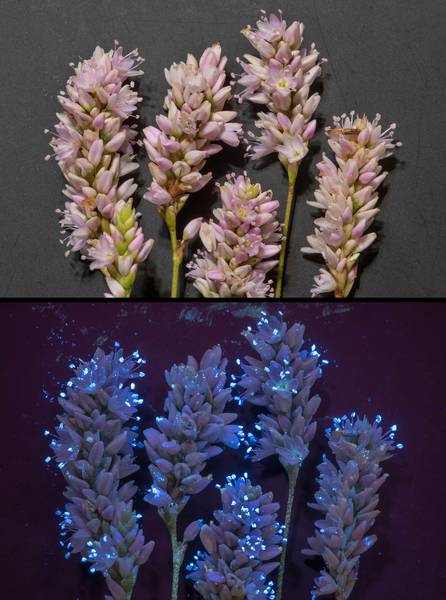

Flowers of smartweed (Persicaria, Polygonum) when exposed to regular daylight as well as when illuminated by a 365 nm ultraviolet (UV-A) blacklight from Washington-on-the-Brazos State Historic Site. Washington, Texas


Album 3611: Washington-on-the-Brazos - College Station, Texas, August 29 - 30, 2024
The image presents two photographs of flowers, showcasing their appearance under normal daylight and when illuminated by a UV-A light source.
In the top photograph, taken during regular daylight, the flowers are depicted as white and pinkish in color. The bottom photograph shows the same flowers exposed to a 365 nm ultraviolet (UV-A) blacklight from Washington-on-the-Brazos State Historic Site.
Upon illumination with the UV-A light, the flowers exhibit a striking transformation, becoming luminous and glowing blue-white in color. This phenomenon is likely due to bioluminescence, where the flowers produce their own light through chemical reactions within specialized cells called photocytes.
This unique property of these smartweed flowers allows them to glow under UV light, making them visible at night or in low-light conditions. This remarkable ability has potential applications in various fields, such as botany, ecology, and even forensic science. – AI vision
🇪🇸 Descripción en español / Spanish Description
Las flores de la mala hierba (Persicaria, Polygonum) cuando se exponen a la luz diurna regular y también cuando se iluminan con una luz negra ultravioleta (UV-A) de 365 nm del Sitio Histórico Estatal Washington-on-the-Brazos. Washington, Texas, agosto de 29 de 2024. La imagen presenta dos fotografías de flores, mostrando su apariencia bajo luz diurna normal y cuando se iluminan con una fuente de luz ultravioleta (UV-A) de 365 nm de Washington-on-the-Brazos State Historic Site. En la fotografía superior, tomada durante la luz diurna regular, las flores se representan de color blanco y rosado. La fotografía inferior muestra las mismas flores expuestas a una luz negra ultravioleta (UV-A) de 365 nm desde Washington-on-the-Brazos State Historic Site. Al iluminarse con la luz UV-A, las flores exhiben una transformación sorprendente, volviéndose luminosas y emitiendo una luz azul blanca. Este fenómeno es probablemente debido a la bioluminiscencia, donde las flores producen su propia luz a través de reacciones químicas dentro de células especializadas llamadas fotocitos. Esta propiedad única de estas flores de mala hierba les permite brillar bajo luz ultravioleta, haciéndolas visibles de noche o en condiciones de poca luz. Esta capacidad notable tiene aplicaciones potenciales en diversos campos, como la botánica, la ecología y hasta la ciencia forense. – Spanish translation