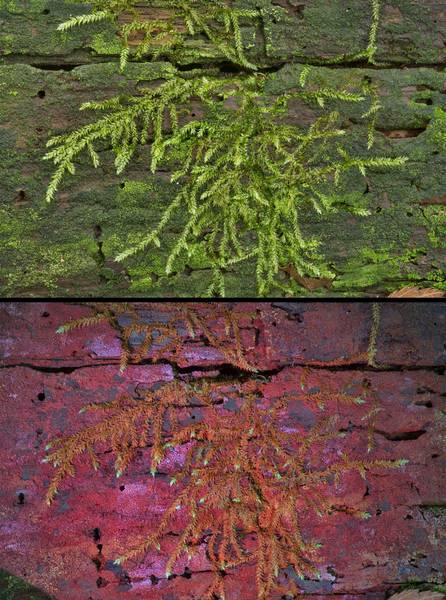

Creeping moss on a wet pine log when exposed to regular daylight as well as when illuminated by a 365 nm ultraviolet (UV-A) blacklight near Pole Creek on North Wilderness Trail of Little Lake Creek Wilderness in Sam Houston National Forest north from Montgomery. Texas


Album 3612: Sam Houston Forest, Texas, August 31, 2024
The photograph depicts two segments of a log, each with moss growing on it and exposed to different lighting conditions. The top segment is illuminated by regular daylight, while the bottom segment is illuminated by a 365 nm ultraviolet (UV-A) blacklight.
**Segment 1: Daylight Illumination**
In this segment, the moss appears greenish-yellow in color and has a more vibrant appearance compared to the UV-A illuminated segment. The leaves of the moss are long and thin, resembling ferns or pine needles. They grow in clusters along the log, with some sections having denser growth than others.
**Segment 2: UV-A Blacklight Illumination**
The bottom segment is exposed to a 365 nm ultraviolet (UV-A) blacklight. This illumination causes the moss to fluoresce and change color, becoming more orange-red compared to its greenish-yellow appearance in daylight. The leaves of the moss are still long and thin, but they appear slightly more rigid and angular under UV-A light.
**Overall Observation**
The photograph highlights the effect of different lighting conditions on the appearance of creeping moss growing on a log. While regular daylight illuminates the moss with its natural color, UV-A blacklight causes it to fluoresce and change color, revealing new details about its structure and growth pattern. This observation suggests that UV-A light can be used to study plant biology and ecology in environments where direct sunlight is limited or absent. – AI vision
🇪🇸 Descripción en español / Spanish Description
El musgo trepador en un tronco húmedo de pino cuando se expone a la luz diurna regular, así como cuando se ilumina con una luz negra ultravioleta (UV-A) de 365 nm cerca del arroyo Pole en el sendero de la selvática norte junto al pequeño lago en el bosque nacional Sam Houston al norte de Montgomery, Texas. El 31 de agosto de 2024. La fotografía representa dos segmentos de un tronco, cada uno con musgo creciendo sobre él y expuesto a diferentes condiciones de iluminación. El segmento superior está iluminado por la luz diurna normal, mientras que el segmento inferior está iluminado por una luz negra ultravioleta (UV-A) de 365 nm.
**Segmento 1: Iluminación diurna regular** En este segmento, el musgo tiene un color verdoso amarillento y su apariencia es más vibrante en comparación con el segmento iluminado con luz negra UV-A. Las hojas del musgo son largas y delgadas, parecidas a las helechos o las agujas de pino. Crecen en grupos a lo largo del tronco, con algunas secciones teniendo un crecimiento más denso que otras.
**Segmento 2: Iluminación con luz negra UV-A** El segmento inferior está expuesto a una luz negra ultravioleta (UV-A) de 365 nm. Esta iluminación hace que el musgo fluoreszca y cambie de color, volviéndose más naranja rojizo en comparación con su apariencia verdosa amarillenta a la luz del día. Las hojas del musgo son todavía largas y delgadas, pero parecen un poco más rígidas y angulares bajo la luz UV-A.
**Observación general** La fotografía destaca el efecto de diferentes condiciones de iluminación sobre la apariencia del musgo trepador que crece en un tronco. Mientras que la luz diurna normal ilumina el musgo con su color natural, la luz negra UV-A hace que el musgo fluoreszca y cambie de color, revelando nuevos detalles sobre su estructura y patrón de crecimiento. Esta observación sugiere que la luz negra UV-A puede usarse para estudiar la biología y ecología de las plantas en entornos donde la luz solar directa es limitada o está ausente. – Spanish translation